Illustration: US Army file photo of a THAAD system being offloaded in Israel for Dynamic Force Employment exercise
The US Army is moving a Terminal High-Altitude Area Defense (THAAD) remote launch package from Guam to Rota, Spain, a service announcement said.
The 94th Army Air and Missile Defense Command (AAMDC) and Joint Region Marianas will deploy a THAAD launcher and associated personnel and equipment to Rota International Airport in the CNMI early March.
A C-17 Globemaster III aircraft from the 15th Wing based out of Joint Base Pearl Harbor-Hickam, Hawai’i will move the equipment from Andersen Air Force Base in Guam to Rota International Airport.
This operation will allow the 94th AAMDC to gather valuable data and inform future deployments of THAAD Remote Launch packages throughout the theater, the announcement said.
While the statement touted to maneuver as an exercise, it comes at a time of high tensions in Europe amid Russia’s invasion of Ukraine. THAAD missiles have a range of around 200 kilometers and can reach altitudes of up to 150 kilometers.
THAAD remote launch is a recently developed capability that allows a THAAD launcher to operate while geographically separated from its Tactical Fire Control Center and radar array. This can expand the amount of area a THAAD battery can defend and allows commanders greater flexibility in deploying the system.
“There is no more important mission than the defense of the homeland – and exercising THAAD’s remote launch capability allows us to enhance the effectiveness of a combat-tested, upper-tier missile defense system
that is vital to the Army’s ability to ensure a free and open Indo-Pacific,” Brig. Gen. Mark Holler, Commanding General of 94th AAMDC said.
“Missile defense is the number one priority for Indo-Pacific command in this region and testing THAAD’s remote launch ability bolsters our defense of CNMI, fortifying our layered defense in the region,” Rear Adm. Benjamin Nicholson, Senior Military Official for CNMI and Joint Region Marianas Commander said.
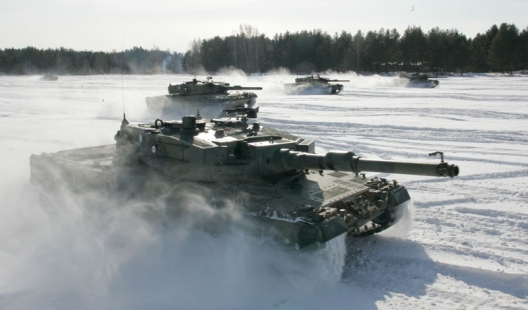
Finland and the Netherlands have agreed to transfer most of the remaining stock of Dutch Leopard 2A6 Main Battle Tanks (MBT) to Finland over a period of four years, for amount around €200 million. Defence Minister Carl Haglund has approved the acquisition of last thursday. Under the agreement Finland will procure 100 Leopard 2A6 tanks from the with the Netherlands, along with logistics package and spare parts sustaining 10 years of operations. The agreement is expected to be signed by on 20 January in the Netherlands by Haglund and his Dutch counterpart, Jeanine Hennis-Plasschaert. Deliveries will commence in 2015 and continue through 2019. . . .
The new tanks will be operated in two mechanized battle groups currently operating Leopard 2A4 MBTs and BMP-2 infantry fighting vehicles. Since the 1980s the Finnish army was operating its tanks in a brigade-size formation. Initially it was operating T-72M1 acquired from the Soviet Union in 1984-1990, when Helsinki bought 160 of the Russian tanks. Two decades later the T-72s were all replaced by 124 Leopard 2A4 tanks Finland bought from German Army surplus. Finland currently maintains 139 Leopard 2A4 in stock, these are expected to be replaced by the Dutch 2A6s toward the end of the decade.
In this photo provided by Lithuanian Ministry of National Defense, Norwegian military vehicles move off trailers as they arrive at an airport in Kaunas, Lithuania, on Feb. 27. (AP)
By Sara Bjerg Moller
Today at 12:21 p.m. EST
Following last week’s announcement by Secretary General Jens Stoltenberg that NATO has activated its Response Force, many are wondering what this means for Ukraine.
On Friday, as Russian forces continued their drive toward Kyiv, Ukrainian President Volodymyr Zelensky took to the airwaves to declare that his country had been “left alone” to mount a defense against one of the most powerful countries in the world. “Who is ready to fight alongside us? I don’t see anyone.”
Ukraine is a NATO partner — but it is not a member of the 72-year-old military alliance. As such, NATO’s Collective Defense pledge (Article 5 of the Washington Treaty) doesn’t apply. In his Feb. 25 televised address, Zelensky pleaded that Ukraine be granted admission to NATO so that the alliance’s 30 members might provide his country desperately needed military assistance.
NATO Secretary General Stoltenberg (and others) are calling the Ukraine invasion the “gravest threat to Euro-Atlantic security in decades.” However, both President Biden and Stoltenberg have made it clear that NATO will not send forces to fight in Ukraine, which is not a NATO ally — because such a move would mean a direct military confrontation between the world’s two largest nuclear powers.
With military intervention ruled out, what might the transatlantic military alliance do next? My research suggests that NATO will continue move swiftly to address Russia’s latest infringement on the sovereignty of another state.
NATO’s goal is to protect the alliance
In the days and weeks ahead, NATO’s actions will be focused almost entirely on enhancing the security and defense of the Central and Eastern European alliance members that border Ukraine and/or Russia. This is a continuation of NATO’s pledge to member countries, and the security organization’s principal task. Since Russia’s annexation of Crimea in 2014, the military alliance has adopted a series of defensive measures along its easternmost border.
NATO’s actions are designed to accomplish three objectives. A primary goal is to deter Russia from taking any steps to violate the territorial integrity of any NATO member. Alliance forces are positioned so that Russia would incur significant cost in the case of any incursion into NATO territory.
Second, these measures are designed to reassure Poland and the Baltic nations — NATO allies that border Russia — that the transatlantic alliance is committed to their defense. By placing other allies’ troops in harm’s way, NATO has made a credible commitment to fight on behalf of its easternmost members.
Third, NATO’s measures are designed to defendthese countries in case of Russian aggression. Deployments are deliberately positioned in a way that buys the alliance time to organize follow-on-forces.
Taking a stand against Russia
In the face of renewed Russian aggression against Ukraine, NATO is doubling down on these objectives. Following Russia’s invasion of Crimea in 2014, NATO established four multinational battlegroups — totaling approximately 4,500 personnel — known collectively as Enhanced Forward Presence. Based in Estonia, Latvia, Lithuania and Poland, and led by the United Kingdom, Canada, Germany and the United States, respectively, the battlegroups include troop contributions from some dozen NATO member countries.
Several allies recently announced plans to send additional personnel and military assets to boost the alliance’s presence in the east. Expect more of this in the coming days.
NATO allies are also committing additional assets to the Baltic Air Policing mission, a 24/7 aerial overflight operation launched one day after the Baltic states joined the alliance in 2004. Since NATO itself owns very few military assets, NATO members must contribute their own jets to the mission to protect an airspace frequently violated by Russian military aircraft. Some allies, like Germany, will find it harder to contribute hardware, as their closets are “bare.”
In addition, the alliance will continue to rely on the NATO Airborne Early Warning and Control Force (AWACs) — one of the few examples of “alliance-owned” military hardware — to monitor alliance airspace. The Boeing E-3 Sentry planes, which provide surveillance and can be used for battle management, are the same assets NATO headquarters deployed to help protect U.S. skies following the 9/11 terrorist attacks.
As anticipated, NATO has already taken steps to prepare for the possible deployment of one element of the response force, the Very High Readiness Joint Task Force, a rapidly deployable multinational brigade currently led by France, by activating the NATO Response Force.
Elements of the response force assisted in NATO’s withdrawal from Afghanistan last summer and could now be deployed for a similar humanitarian mission to help Ukraine’s NATO neighbors prepare for large numbers of refugees already arriving in Poland, Hungary and Romania.
What about Ukraine?
Other potential steps NATO could take include providing Ukraine with communication and information support about Russian troop movements.
But here, too, NATO is likely to proceed with caution because, as a defensive alliance, it cannot take actions that could be construed as offensive in nature. In addition, the U.S. government has long had concerns that Russian agents have infiltrated Ukraine’s defense and other government services, meaning the allies are likely to be judicious when it comes to sharing the latest intelligence with Kyiv.
Apart from these moves, which are taken by the organization collectively, individual NATO allies have increased their arms deliveries to the Ukrainian military. Over the weekend, Sweden — like Ukraine, a NATO partner — announced it would also send military aid (including weapons) to the Ukrainian government.
In short, NATO has lots of tools designed for addressing exactly the scenario that is unfolding in Ukraine. But, for now, expect NATO to continue to prioritize actions that will simultaneously signal its resolve while avoiding steps that could inadvertently lead to a military confrontation with Russia.
Sara Bjerg Moller is an assistant professor (on leave) at Seton Hall University’s School of Diplomacy and International Relations and a former Eisenhower Defense Fellow at the NATO Defense College.
The Biden administration has approved the sale of 16 F-16 Fighting Falcon fighters to Jordan. Here, Jordanian and U.S. F-16s wait on the flightline at Misawa Air Base, Japan, during a 2014 exercise. (Staff Sgt. Tyler McLain/Air Force)
The Biden administration said Thursday it has cleared a possible sale of as many as 16 F-16 fighters and related equipment to Jordan worth up to $4.21 billion.
The State Department also approved a possible additional sale to the United Arab Emirates of spares and repair parts for air defense systems that would bring its value up to $65 million, as well as a possible $23.7 million sale to Saudi Arabia for data and voice communication systems. The Defense Security Cooperation Agency notified Congress on Thursday of the possible foreign military sales.
Jordan wants to buy as many as 12 F-16C and four F-16D fighters, all Block 70s, as well as 21 F100 engines, either made by General Electric or Pratt & Whitney, five of which would be spare engines. Lockheed Martin in Greenville, South Carolina, will be the principal contractor for this sale.
The arms package would also include numerous weapons and systems to arm the fighters, such as six AN/AAQ-33 Sniper Advanced Targeting Pods, 72 LAU-129 missile rail launchers, 21 M61A1 Vulcan cannons, 100 KMU-556 Joint Direct Attack Munition tail kits for 2,000-pound GBU-31 bombs, 102 KMU-572 JDAM tail kits for 500-pound laser JDAM GBU-54 bombs, 200 MK-84 or BLU-117 or equivalent bomb bodies, 204 MK-82 or BLU-111 or equivalent bomb bodies, ammunition, smoke flares and flare cartridges.
Jordan also wants to buy 31 Link 16 Low-Volume Terminals for both aircraft and ground stations, radars, mission computers, GPS navigation systems with anti-spoofing modules and multiple other pieces of equipment.
The sale would mean fewer than 20 U.S. contractors would be assigned to Jordan for three years to provide on-site logistics support.
State said the fighter sale would help modernize Jordan’s air force and make sure its military can continue to work together effectively with U.S. and coalition forces on common goals such as fighting terrorist or other violent extremist groups.
A THAAD interceptor is launched from the Reagan Test Site, Kwajalein Atoll in the Republic of the Marshall Islands, during Flight Test THAAD-23 on Aug. 30, 2019. (Missile Defense Agency)
The UAE Foreign Military Sales Order would provide more spares and repair parts for the Homing All the Way Killer, or HAWK, Phased Array Tracking Radar to Intercept on Target, or Patriot, and Terminal High Altitude Area Defense, or THAAD, weapons systems, as well as additional logistics and other support.
State had already approved a deal for this equipment in a previous $30 million sale; the latest proposed amended foreign military sale case would extend that by three additional years and bring the total value to $65 million.
The sale approval comes weeks after UAE used one of its THAAD systems to intercept a ballistic missile during a Jan. 17 attack by Houthi militants in Abu Dhabi, which marked the first time THAAD is known to have been used in a military operation. The Lockheed Martin-made system destroyed a midrange ballistic missile fired at an Emirati oil facility near Al Dhafra Air Base, which hosts U.S. and French forces.
Saudi Arabia is also approved to buy 31 Block 2 Multifunctional Information Distribution System-Low Volume Terminals, or MIDS-LVTs. These will be added to a previous $3 million sale of 11 Block 1 MIDS-LVTs.
The newly-purchased MIDS-LVTs are intended to be installed on THAAD platforms. The first round of MIDS-LVTs were installed on Patriot systems.
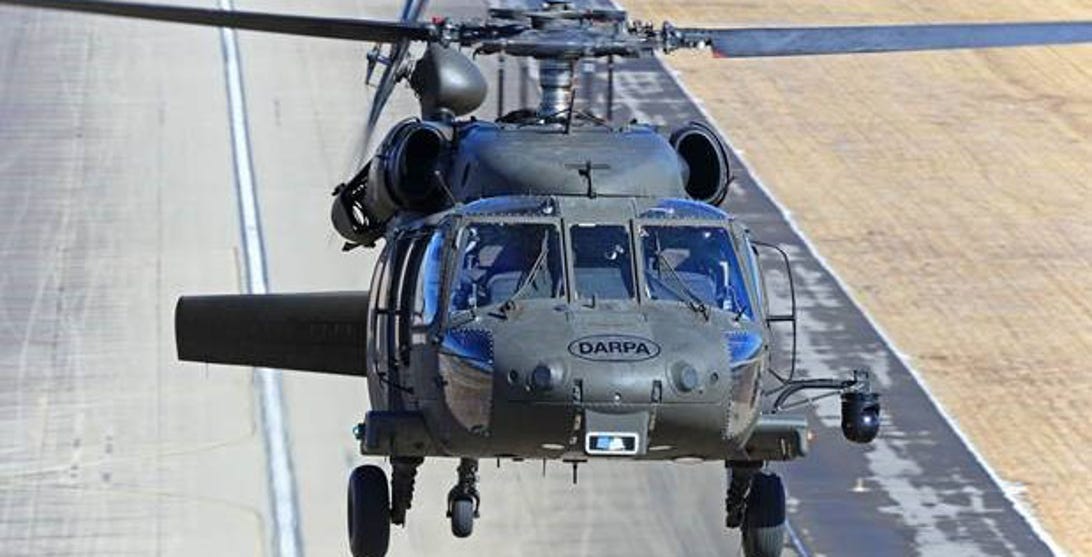
DARPA flies a Black Hawk helicopter without a pilot for 30 minutes
The Black Hawk is kitted out with Sikorsky Matrix autonomous flying technology.
DARPA’s ALIAS program was used to fly the helicopter autonomously.
The Black Hawk was kitted out with Sikorsky Matrix autonomous flying technology, and DARPA says it repeated the “uninhabited flight” on Monday.
“Pilots can focus on mission management instead of the mechanics,” Stuart Young, program manager in DARPA’s Tactical Technology Office, said in a statement. “ALIAS … includes the ability to operate aircraft at all times of the day or night, with and without pilots, and in a variety of difficult conditions, such as contested, congested, and degraded visual environments.”
The US military has been experimenting with autonomous helicopters for years. For instance, the Navy has been evaluating Northrop Grumman’s unmanned MQ-8C Fire Scout for close to a decade, and a self-flying K-Max helicopter delivered cargo to Marines in remote locations in Afghanistan.
From the lab to your inbox. Get the latest science stories from CNET every week.
The use of artificial intelligence in military applications is undeniably growing. While many systems are at an experimental stage, the technology is maturing rapidly.
At the end of 2021, NATO officially implemented its first artificial intelligence (AI) strategy. The paper sets out the challenges the military faces when using AI and recognises six basic principles for using it responsibly, with collaboration at the forefront. Similarly, the UK Ministry of Defence’s (MOD) executive research agency the Defence Science and Technology Laboratory (Dstl) stresses the importance of responsible and trustworthy use of AI applications.
NATO strategy
The NATO document says AI will support the alliance in its three core tasks: collective defence, crisis management and cooperative security. The strategy also presses the importance of committing to collaboration and cooperation among member states if NATO is to retain the technological edge. This would include allies and members building on existing adoption efforts to ensure interoperability, and standardisation, which is integral to NATO.
AI technology is evolving at a radical pace and the potential capabilities it offers are clear. But how NATO will manage to harmonise different countries’ approaches remains an issue, International Institute for Strategic Studies (IISS) research fellow for defence and military analysis Dr Simona R. Soare believes.
“For countries like the United States, it is a priority that allies agree practical guidelines for the operational use of AI-enabled systems and the necessary data-sharing, a challenge that should not be underestimated,” she wrote in an IISS blog post.
“Some allies, meanwhile, are not satisfied with the granularity of the six principles of responsible use, while others consider that overemphasising the normative approach risks ceding technological advantage to peer competitors.”
The six principles are lawfulness, responsibility and accountability, explainability and traceability, reliability, governability and bias mitigation. While the strategy aims to provide a foundation for NATO and its allies to encourage the progress of AI applications by responsible means, it also aims to protect and monitor its related technologies and innovative aspect by addressing security policy considerations.
Soare thinks, however, that the extent to which NATO is willing to adopt AI is also questionable.
She says: “The strategy is meant to be implemented in a phased approach, partly to build political support for AI military projects. Initial ambitions seem modest, reportedly focusing on mission planning and support, smart maintenance and logistics for NATO capabilities, data fusion and analysis, cyber defence, and optimisation of back-office processes. As political acceptance grows and following periodic reviews of the strategy’s implementation, the goal is to also include more complex operational applications.”
The strategic document, Soare says, is not clear on the allocation of roles and resources of the different NATO and national innovation bodies, and how each body would coordinate to implement the AI strategy.
“While NATO has adopted the AI strategy, there is no dedicated line of funding for it. Finance will depend on a combination of common budget funding and off-budget mechanisms such as the NATO Innovation Fund. Besides the uncertainty over the availability of funding, some Alliance agencies are concerned that their budgets could be cut and redistributed towards the implementation of the AI strategy,” she writes in her blog.
Delivering AI for the UK
“Future conflicts may be won or lost on the speed and efficacy of the AI solutions employed,” says the 2021 Defence Command Plan.
Drawing upon the MOD’s Integrated Review, Defence Command Plan and Integrated Operating Concept, Dstl’s vision sets out the roadmap of how to deliver AI and automation capabilities rapidly. Dstl believes that the one thing that connects future physical systems, virtual systems and data science is AI.
At the heart of the delivery approach lies continuous development and experimentation that involves agile software development and close end-user engagement. The vision recognises the importance AI will play in multi-domain integration, but equally understands the importance of collaboration between the UK Government, the military, industry and tech sector in delivering the AI vision.
The approximate funding allocated for suppliers to work with Dstl on AI projects is £7m in the financial year 2021/22 but is set to increase to £29m in the next one.
Similarly to the NATO strategy, Dstl aims to help the MOD understand how AI can be adopted ethically and responsibly while it enhances defence capabilities. Potential applications developed under this vision include autonomous platforms, computer network defence, sensing, logistics and security. To achieve these, however, requires establishing user confidence and making adoption easier.
Successful AI applications
Dstl opened its new National Innovation Centre for Data in Newcastle (NICD) last year, expanding the UK’s capabilities by creating a new AI and data science unit. The NICD addresses the shortage of data analytics skills in the country and helps companies and organisations to exploit data.
But it is not all about concepts and research. At a successful sea demonstration in 2021 during a three-week NATO exercise called Formidable Shield, the Royal Navy tested two AI-based applications on the Type 45 Destroyer HMS Dragon and Type 23 Frigate HMS Lancaster.
Canadian IT expert CGI’s System Coordinating Integrated Effect Assignment (SYCOIEA) platform detects supersonic missile threats earlier than conventional systems and provides a rapid hazard assessment to commanders so they can take the most adequate countermeasure option.
The second system was British engineering company Roke’s autonomous Startle system, designed to support sailors with continuous monitoring. It can detect contacts that exhibit anomalous or suspicious behaviours and create alerts to operators to enhance preparedness and counter-action.
Meanwhile, on the ground, soldiers from the 20th Armoured Infantry Brigade deployed an AI engine prototype specifically designed for British Army operations. The system was developed by Dstl and the Army Headquarters Directorate of Information and defence industry partners, including IBM, ESRI and Janes.
It aims to save time and effort, and can help personnel operate more effectively by quickly analysing the surroundings and providing information. The demonstration aimed to explore ways to build trust in the AI system.
M1 Abrams are the only active main battle tanks of the US Army
Via: Sgt. Christopher McCullough
Main battle tanks are key military weapons as they provide direct fire and durability on the battlefield. Today, it’s common to see military units that consist of main battle tanks only, as these weapons are advanced enough to perform operations without other units. In modern years, their impressive development led to awesome machines with very powerful armor and high-tech systems.
Some top-class battle tanks are the Challenger 2 of the United Kingdom, the K2 Black Panther of South Korea, and the German Leopard 2A7. For many, the German tank wins any comparison, something that makes it the most powerful in the world. The best American of this kind, the M1A2 SEP, is not far behind the European masterpiece. The US Army battle tank is a part of the M1 Abrams line that started back in 1979.
M1 Abrams
Via: US Air Force
The M1 Abrams are legendary tanks that started serving the US Army in 1980. They have proved countless times their reliability and effectiveness as they have served in the Gulf War, the War in Afghanistan, the Iraq War, the 2011 Egyptian revolution, and more. The manufacturing companies are the Lima Army Tank Plant and the Detroit Arsenal Tank Plant (from 1982 to 1996). Their designer is Chrysler Defense, which have now the name General Dynamics Land Systems. In total, the companies built more than 10,000 units.
The M1A2 Abrams are third-generation main battle tanks and some of the heaviest in the world. Currently, there are three operational versions of the Abrams line: the M1, the M1A1 and the M1A2. The US Army was planning on replacing the tanks with the Future Combat Systems XM1202, but the project got canceled. Now, the the Army plans on maintaining the current Abrams and upgrade them in any possible way.
The MIA2 started production in 1986 and the first one started serving for the US Army in 1992. The M1A2 provides the tank commander with a thermal sight and can shoot two targets at the same time. The armor consists of second generation depleted uranium.
Then, the System Enhancement Package (SEP) upgrade came and changed the already improved capabilities of the M1A2. The M1A2 SEP is still today the backbone of the armored forces of the United States. In total, the US built 240 new M1A2 SEPs, upgraded 300 M1A2 thanks to the SEP version, and also upgraded 400 M1A1s to the MI1A2 SEP configuration.
The armor of the SEP version has upgraded deplete uranium components that makes it one of the best in the world. The Army can extend the level of protection by adding explosive reactive armor. The weapon of the tank is the 120 mm M256 that has a range of 2.5 miles. The weapon shoots M829A3 APFSDS ammunition and M1028 rounds. The second choice is an excellent ammunition against infantry targets at the range of 0.12 to 0.3 miles.
There is a modern and capable fire control system in the tank with a ballistic computer. The two thermal sights use second generation FLIR technology that also provides night vision capabilities. The main battle tank also features a digital battlefield management system that can distinguish friendly and enemy targets. The system display at live-time the location of nearby friendly vehicles. The crew of four includes the commander, the gunner, the loader, and the driver. The AGT 1500 gas turbine engines develop 1,500 hp and provides decent performance to the vehicle.
Its thick armor and powerful 88 mm gun meant it could take on pretty much anything that Britain, America and the Soviet Union had.
via Tank Encyclopedia
In the earlier years of the Second World War, Germany’s technological and military might kept it well ahead of the opposition. It had aircraft such as the Messerschmitt Bf 109, and of course had perfected its tactics when out on the battlefield. What it also had was a lot of highly developed, well armored and powerful tanks that could take on pretty much anything the Allied forces could throw at them. Then in 1942, the German’s introduced a tank that would strike fear and terror into the minds of many an Allied solider and tanksmen.
The tank was officially called the Panzerkampfwagen VI Tiger Ausf. E. It is better known to us though as the Tiger I. The Tiger tank was first seen in 1942 in Africa and the Soviet Union, and it was one of the most fearsome tanks ever built. Its thick armor and powerful 88 mm gun meant it could take on pretty much anything that Britain, America and the Soviet Union had. There were some issues surrounding it, such as its low production output and its complexity, but despite those problems, the Tiger I was able to instill fear into Allied ground forces like no other vehicle ever built.
The Development Of The Tiger I
via Tank Encyclopedia
The origin of the Tiger I can be traced back to early 1937, with attempts by Henschel & Sohn to create a large tank for the German Army’s Weapons Agency, the Waffenamt. However, the real need for the Tiger I came around 1941. When Germany encountered the large numbers of Soviet T-34s and KV-1s in Operation Barbarossa, they were utterly stunned by the potent nature of these tanks. The development of a new heavy tank was rapidly accelerated, and it ultimately led to the Tiger I after a few prototypes.
via Tank Encyclopedia
Porsche and Henschel competed for the contract, with the latter company winning out. What they created was a leviathan of a tank. The fearsome 88 mm flak gun would be the primary armament, and at it’s maximum the Tiger I’s armor would be as strong as 120 mm. It was powered by the 690 hp Maybach HL230 P45 V12 engine, with a maximum speed of 28 mph on the roads, and around 16 cross-country. Overall, the Tiger I weighed in at around 57 tonnes at its combat weight. A light tank, this was most certainly not.
Ironically, the first known operational usage by Tigers, four of them at Leningrad in 1942, was quite underwhelming. All four were knocked out after being deployed on swampy terrain. But, the German’s soon developed their tactics with the tank, and used the heavy armor of the Tiger to its advantage. It was that armor that made the Tiger so terrifying, as Allied forces, particularly the British in North Africa, found that it was almost impenetrable, apart from around the back of the tank where the engine was. Of course, you had to somehow get around the back of the tank!
via Wikipedia
Certain stories about Tiger tanks helped cement the “Tigerphobia” experienced by Allied forces, Michael Wittman is undoubtedly the greatest Tiger tank commander ever. In one particular action in Normandy on June 13th 1944, Wittmann and his Tiger crew were able to destroy around 14 tanks and 15 personnel carriers, plus two anti-tank guns, within a period of around 15 minutes. This was a truly staggering achievement, and perhaps highlighted just how effective the Tiger I could be if used effectively by its commanders. But it wasn’t all easy going for the Tiger.
The Issues That The Tiger I Faced
via The War Games Website
One issue with the Tiger I was, due to its large tracks, it was a nightmare to transport. The tracks had to be changed for rail transport before its bigger, combat tracks were refitted when it arrived at the front. Reliability, as with a lot of German tanks, also hurt the Tiger I. This was mainly due to issues with the engine and transmission. The interleaved wheels were a nightmare if mud and ice got into them, and repairs to other wheels could take quite a while. And ultimately, the advent of tanks like the Sherman Firefly and the Churchill, plus better anti-tank guns, meant the Tiger would no longer be “invincible”. But the biggest issue, by far, was that only 1,347 Tiger I’s were ever built. Ally this with the fact that tanks such as the Sherman were so numerous, and that the Allies developed tactics to beat the Tiger I, the tank soon found itself facing stiff competition.
Senior Airman Cameron Manson inspects cargo netting on palletized ammunition, weapons and other equipment bound for Ukraine during a Foreign Military Sales mission at Dover Air Force Base, Del., on Jan. 24, 2022. (Roland Balik/U.S. Air Force)
WASHINGTON ― The Pentagon on Tuesday provided more details about the $200 million military aid package for Ukraine approved by President Joe Biden in December.
“This package includes additional Javelin and other anti-armor systems, grenade launchers, munitions, and nonlethal equipment essential to Ukraine’s front-line defenders,” said Marine Corps Lt. Col. Anton Semelroth, a Pentagon spokesman. “Those deliveries are ongoing.”
The U.S. Embassy in Ukraine on Tuesday afternoon reported that 79 tons of security assistance, including about 300 Javelins, arrived in Kyiv.
The package was not announced previously, but CNN broke news of the approval earlier this month.
“We have a $200 million package that the president just approved right before Christmas that we are now fulfilling,” Pentagon spokesman John Kirby told Fox News on Monday. “I think there’s been at least two, maybe three deliveries already just in the last few days. And they will include additional Javelin anti-tank missiles. They will include some air defense systems. They will include small arms and ammunition, certainly medical support, that kind of thing.”
On Monday, State Department spokesman Ned Price told reporters that the latest tranche, authorized in December, arrived in Kyiv overnight Friday and into Saturday.
This week, the Pentagon put roughly 8,500 troops on a heightened alert in case of a Russian incursion into Ukraine, and Washington allowed the Baltic states to send American-made weapons to Ukraine.
Since 2014, the United States has committed more than $2.7 billion in security assistance to build the capacity of Ukraine’s forces, including more than $650 million in 2021 alone.
A setup of the British military’s Land Environment Air Picture Provision (LEAPP) is pictured in 2015. (British Army photo, via Wikimedia Commons)
LONDON – The British Army is upgrading its existing command-and-control, battlespace-management capabilities in a deal with Lockheed Martin UK that the contractor originally declined to bid on.
The company announced it had secured the contract Jan. 26, saying that the work would enable the early-air-defense-warning system’s out-of-service date to be extended several years to 2029.
The UK arm of Lockheed Martin, based at Ampthill in southern England, developed and supplied the system, known as the Land Environment Air Picture Provision program, or LEAPP for short, to the British in 2014, providing air situational awareness to deployed land headquarters.
LEAPP has been deployed across the world with the British Army, and most recently was deployed as a surveillance capability at two high-profile global events hosted by the UK: the G7 2021 Summit in Cornwall and the COP 26 Summit in Glasgow.
The British Army now wants to update the system and address several obsolescence issues to see the capability through to its new retirement date.
“The extended out-of-service date cements LEAPP’s importance within the land environment and air picture exchange within the land environment, so they [the MoD] saw this as a really key capability and they needed to have the obsolescence issues resolved so that it could be taken forward,” said Richard Turner, Lockheed Martin UK’s SkyKeeper business development manager.
SkyKeeper, is currently the battle management command, control, communications, computers and intelligence (BMC4I) component of the LEAPP program and a key element in Lockheed Martin’s international sales effort in the sector.
But when the Ministry of Defence originally issued its requirements to potential industry bidders Lockheed Martin, the incumbent supplier, said it couldn’t be done for the £10 million ($13.5 million) price tag the military had in mind and opted to forgo a bid.
“The MoD was trying to be as diligent as they could in order to get a capability as cheap as possible and we were just being honest and saying we can’t do what you want for that amount,” said Turner.
A handful of contractors did bid for the LEAPP update but ran into similar issues as Lockheed Martin UK. “The MoD sought potential resolution from other companies, but basically the rest of industry were unable to provide the capability the MoD needed for the money they wanted to spend either,” said Turner.
“Also, we were confident LEAPP is a tremendous capability the Army had and all they needed to do was upgrade that system by finding a little extra money to enable it to be cost effective for us to do it,” said Turner.
That, effectively, is what happened. The deal Lockheed Martin UK and the MoD settled on had a price tag in the region of £20 million, or $27 million.
Despite the LEAPP contract announcement only being made public on Jan. 26 work on the program has been underway at Ampthill for several months.
To avoid entry into service timelines becoming too squeezed a first release of funds by the MoD last summer allowed Lockheed Martin to get ahead of the game on updating LEAPP, said Turner.
The announcement Jan 26 represents the final phase of the contract award.
The enhanced system will boost the Army’s existing command-and-control capability and enable it to effectively communicate via upgraded Link 16 capabilities and seamlessly plug into the wider UK defense digital backbone.
Nobody is saying exactly when the update will be complete, but the MoD’s decision to speed the program along with initial funding last year suggests the work will be finished sooner rather than later.
Updating LEAPP is part of a wider push by the British military to improve ground based air defense capabilities.
The MBDA Land Ceptor missile, called Sky Sabre by the British, became operational in the Falklands Islands last year aligned with Saab’s Giraffe surveillance radar.
Further orders for the Common Anti-Air- Modular missile and related systems for the British Army were promised in last year’s defense review but have yet to be agreed with industry.


:quality(70)/cloudfront-us-east-1.images.arcpublishing.com/mco/2D5UVFI7YVES7MSZXFPDEZUHMM.jpg)
:quality(70)/cloudfront-us-east-1.images.arcpublishing.com/mco/BZH2QH4N7ZBRTCA2RRYPK6T5UM.jpg)



.jpg?q=50&fit=crop&w=750&dpr=1.5)


.jpg?q=50&fit=crop&w=750&dpr=1.5)

:quality(70)/cloudfront-us-east-1.images.arcpublishing.com/mco/T2ASXOTOXZHV5G7ZANSIPBR74Y.jpeg)
:quality(70)/cloudfront-us-east-1.images.arcpublishing.com/mco/NIZUFDX2XNDX3FVQ56QA2MXSU4.jpg)