PartYard Defense
The U.S. Army’s recent decision to choose the Bell V-280 Valor over the UH-60 Black Hawk as its next-generation vertical lift platform has generated a significant amount of discussion and debate within the defense industry. The V-280 and UH-60 are both advanced, highly capable aircraft, and the choice between them will have a major impact on the Army’s future capabilities and operations.
The V-280 is a tiltrotor aircraft, which means that it can take off and land like a helicopter, but also fly like an airplane. This unique capability allows the V-280 to achieve much higher speeds and ranges than traditional helicopters, making it well-suited for a wide range of missions, including reconnaissance, transport, and attack. The V-280 has a cruise speed of 280 knots, which is significantly faster than the UH-60’s cruise speed of 150 knots. Additionally, the V-280’s range of 2,100 nautical miles is more than double that of the UH-60.

The V-280 is a tiltrotor aircraft, which means that it can take off and land like a helicopter, but also fly like an airplane. This unique capability allows the V-280 to achieve much higher speeds and ranges than traditional helicopters, making it well-suited for a wide range of missions, including reconnaissance, transport, and attack. The V-280 has a cruise speed of 280 knots, which is significantly faster than the UH-60’s cruise speed of 150 knots. Additionally, the V-280’s range of 2,100 nautical miles is more than double that of the UH-60.
One of the key advantages of the V-280 over the UH-60 is its superior maneuverability. The V-280’s tiltrotor design allows it to achieve much higher speeds and altitudes than traditional helicopters, which gives it a significant advantage in both air-to-air and air-to-ground engagements. Additionally, the V-280’s advanced avionics and sensor suite give it superior situational awareness and targeting capabilities, making it an ideal platform for reconnaissance and attack missions.
The V-280 is also more efficient than the UH-60. The tiltrotor design of the V-280 allows it to achieve much higher speeds and ranges than traditional helicopters, which reduces fuel consumption and increases flight time. Additionally, the V-280’s advanced avionics and sensor suite allow it to fly more precise routes, which can further reduce fuel consumption and travel time.
However, the UH-60 has its own set of advantages. The UH-60 has been in service for several decades, and has proven itself to be a highly capable and reliable aircraft. The UH-60’s simple and robust design makes it easy to maintain and operate, which is an important consideration for an aircraft that is often used in austere and remote locations. Additionally, the UH-60’s low cost and proven capabilities have made it a favorite among military and civilian operators around the world.
Another advantage of the UH-60 is its proven track record in combat operations. The UH-60 has been used in numerous conflicts around the world, and has proven itself to be a highly capable and durable aircraft. This has led to a high degree of familiarity and comfort among pilots and aircrews, which can be an important consideration when selecting a new aircraft.
In conclusion, the U.S. Army’s decision to choose the Bell V-280 Valor over the UH-60 Black Hawk as its next-generation vertical lift platform is a significant one that will have a major impact on the Army’s future capabilities and operations. The V-280 is a highly advanced aircraft that offers a number of advantages over the UH-60, including superior speed, range, maneuverability, and efficiency. However, the UH-60 has its own set of advantages, including its proven track record, ease of maintenance and operation, and low cost. Ultimately, the choice between the V-280 and UH-60 will depend on the specific needs of the Army and the nature of the missions it will be required to perform in the future.
Call us Today: +351 265544370
Email: sales@partyardmilitary.com

The transition to performance-based navigation (PBN) operations by helicopter UH-60 requires a comprehensive understanding of the technology and its implementation. PBN is a type of navigation that uses performance-based criteria, such as time, fuel, and distance, to determine the most efficient flight path for a given aircraft. This approach is in contrast to traditional navigation, which relies on ground-based navigation aids, such as VORs and NDBs.
The UH-60, also known as the Black Hawk, is a versatile and widely-used helicopter that is well-suited for PBN operations. The helicopter’s advanced avionics system, including its GPS receiver and flight management system, allow it to easily navigate using PBN criteria. Additionally, the UH-60’s powerful engines and advanced rotor system make it capable of flying at high speeds and altitudes, which is essential for PBN operations.
Before transitioning to PBN operations, pilots and aircrews must receive training on the technology and its use. This training typically includes classroom instruction on the principles of PBN navigation, as well as hands-on training using simulators and actual aircraft. The training also covers the specific procedures and protocols that must be followed when conducting PBN operations.

Once the training is completed, the UH-60 can begin PBN operations. The first step in this process is to create a flight plan that takes into account the aircraft’s performance capabilities and the specific PBN criteria that will be used. This plan is then loaded into the aircraft’s flight management system, which uses GPS data to guide the aircraft along the planned route.
During the flight, the aircraft’s avionics system continually monitors the aircraft’s position and performance, making adjustments as necessary to ensure that the PBN criteria are met. The pilot and aircrew also have the ability to manually adjust the flight plan as needed, such as to avoid weather or other obstacles.
One of the major benefits of PBN operations is increased safety. PBN navigation allows aircraft to fly more precise routes and avoid ground-based navigation aids that may be out of service or unreliable. Additionally, PBN operations allow aircraft to fly at higher altitudes, which can reduce the risk of bird strikes and other hazards.
PBN operations also result in increased efficiency. By using performance-based criteria, aircraft can fly the most efficient routes, which can reduce fuel consumption and travel time. This can result in significant cost savings for operators.
In conclusion, transitioning to PBN operations by helicopter UH-60 requires a comprehensive understanding of the technology and its implementation. Pilots and aircrews must receive training on the technology and its use, and the UH-60’s advanced avionics system, including its GPS receiver and flight management system, allow it to easily navigate using PBN criteria. PBN operations result in increased safety and efficiency, which can result in significant cost savings for operators.
Call Us today: +351 265544370
Email: sales@partyardmilitary.com

The M113 is a tracked armored personnel carrier that was developed by the United States Army in the early 1960s. The vehicle was designed to transport troops and provide them with armored protection in the battlefield. The M113 has been used by the US Army and many other countries around the world, and it has seen action in a variety of conflicts, including the Vietnam War, the Gulf War, and the Iraq War.

The M113 is powered by a Detroit Diesel 6V53T diesel engine. The 6V53T is a two-stroke, six-cylinder, V-type engine that has a displacement of 318 cubic inches (5.2 liters). The engine is rated at 210 horsepower (157 kW) at 2,800 RPM and can produce 440 lb-ft of torque (597 Nm) at 1,800 RPM. The engine is coupled to an Allison TX-100-1 transmission which is a three-speed, fully automatic transmission that provides the M113 with a top road speed of 45 mph (72 km/h).
The 6V53T engine is known for its reliability and durability. The engine is relatively simple in design and is relatively easy to maintain. The engine’s two-stroke design also makes it easy to start in cold weather, and it is resistant to sand and dust ingestion which is important in desert and desert-like environments. The engine’s low-end torque also provides the M113 with good off-road mobility.
The M113 is an armored personnel carrier that can carry up to 11 fully-equipped soldiers. The vehicle is equipped with a number of features that provide the occupants with protection from small arms fire and shrapnel. The vehicle’s armor is made of aluminum alloy, which provides a good balance between weight and protection. The vehicle is also equipped with a number of vision ports and periscopes, which provide the occupants with a good field of view.
The M113 is also equipped with a number of weapons systems that can be used for self-defense. The vehicle is typically armed with a .50 caliber machine gun or a 40mm automatic grenade launcher. The vehicle can also be armed with an 81mm mortar or a TOW missile launcher. The vehicle’s weapons systems are operated by the vehicle’s commander and gunner.
The M113 has been used by the US Army and many other countries around the world. The vehicle has seen action in a variety of conflicts, including the Vietnam War, the Gulf War, and the Iraq War. The vehicle’s versatility and reliability have made it a popular choice among militaries around the world. The M113 is still in service with many countries today, and it is expected to remain in service for many years to come.
In conclusion, the M113 is a tracked armored personnel carrier that was developed by the United States Army in the early 1960s. The vehicle is powered by a reliable and durable Detroit Diesel 6V53T diesel engine. The engine provides the vehicle with good mobility, both on and off-road, and it is relatively easy to maintain. The M113 is also equipped with a number of features that provide the occupants with protection from small arms fire and shrapnel. The vehicle’s versatility and reliability have made it a popular choice among militaries around the world and it is still in service today.

The Leopard 2 is a main battle tank that was developed by the German company, Krauss-Maffei Wegmann (KMW). It has been in service with the German Army since 1979 and is considered to be one of the best tanks in the world. The Leopard 2 has been used by several other countries, including Canada, Denmark, Greece, the Netherlands, Poland, Spain, and Switzerland.
The Leopard 2A4 is the most widely used variant of the Leopard 2 tank in Europe. It is equipped with a 120mm smoothbore gun that is capable of firing a variety of rounds, including high-explosive, anti-tank, and canister shots. The tank is also equipped with a 7.62mm machine gun, which is used for anti-personnel and anti-aircraft defense.
The Leopard 2A4 is heavily armored and is protected by a combination of steel, ceramic, and composite materials. The tank’s armor can withstand hits from most anti-tank rounds, making it highly resistant to enemy fire. The tank’s design also includes a number of features that help to protect the crew, including an automatic fire suppression system and an NBC (nuclear, biological, and chemical) protection system.
The Leopard 2A4 is also highly mobile, with a top road speed of 72 km/h (45 mph). It is powered by a V-12 diesel engine that provides it with a high power-to-weight ratio, allowing it to move quickly and easily across rough terrain. The tank is also equipped with a hydropneumatic suspension system that helps to smooth out the ride and improve the crew’s comfort.

In terms of firepower, the Leopard 2A4 is considered to be one of the most capable tanks in the world. Its 120mm smoothbore gun is capable of penetrating most modern tank armor, and its advanced fire control system allows the crew to engage targets quickly and accurately. The tank’s high-explosive rounds are also capable of causing significant damage to buildings and other structures, making it a valuable asset in urban combat scenarios.
The Leopard 2A4 is also highly modular and can be easily upgraded with new technologies as they become available. This allows countries that use the tank to keep it relevant and capable in the face of evolving threats. Countries like Denmark, The Netherlands, Canada, and Poland have all upgraded their Leopard 2A4 tanks with advanced technologies such as new communication systems, active protection systems, and improved armor.
In conclusion, the Leopard 2A4 is a highly advanced and capable main battle tank that is used by several countries in Europe. It is well-protected, highly mobile, and armed with a powerful 120mm smoothbore gun. The tank’s advanced fire control system and high-explosive rounds make it a valuable asset in both urban and traditional combat scenarios. The tank’s modular design also allows it to be easily upgraded with new technologies, making it a relevant and capable weapon system well into the future.
The United States Air Force (USAF) is currently developing its next generation of air dominance fighters, known as the Next Generation Air Dominance (NGAD) program. This new fighter aircraft is expected to be a game-changer in the world of air warfare, with advanced capabilities that will allow it to dominate the skies in any future conflicts.
One of the key features of the NGAD fighter is its stealth capability. The aircraft is designed to be highly stealthy, making it difficult for radar systems to detect it. This will allow it to evade enemy air defenses and strike targets with precision. The NGAD will also be equipped with advanced sensors and avionics, allowing it to detect and track targets at long ranges.
Another important aspect of the NGAD is its ability to operate in a variety of roles. The aircraft will be able to perform air-to-air combat, air-to-ground strikes, and reconnaissance missions. This versatility will give the USAF the ability to respond to a wide range of threats and challenges, making it a valuable asset in any future conflicts.
The NGAD will also be equipped with advanced weapons systems, including air-to-air and air-to-ground missiles, as well as a variety of bombs and other ordnance. These weapons will give the aircraft the ability to engage and destroy a wide range of targets, including aircraft, ground vehicles, and buildings.
In terms of propulsion, NGAD is expected to feature a combination of traditional turbofan engines and advanced propulsion systems such as Pulse Detonation Wave Engines (PDWEs) which are engines that use detonation waves to compress air and fuel before combustion. This technology is still in the experimental phase and the NGAD program is expected to help accelerate its development.
The NGAD is also designed to be highly maneuverable, with advanced flight control systems that will allow it to perform a wide range of maneuvers, including high-g turns, vertical climbs, and supersonic flight. This will give the aircraft an advantage in air-to-air combat, allowing it to outmaneuver and outgun enemy fighters.
The NGAD program is still in the early stages of development, and it will likely be several years before the aircraft is ready for deployment. However, the USAF is already planning for the future, and the NGAD fighter is expected to play a key role in maintaining American air superiority in the years to come.
In conclusion, the Next Generation Air Dominance (NGAD) fighter is a highly advanced aircraft that is being developed by the United States Air Force (USAF) to maintain air superiority in the future. With advanced stealth capabilities, versatile roles, advanced weapons systems, advanced propulsion systems, and highly maneuverable, it will give the USAF the ability to respond to a wide range of threats and challenges. The program is still in the early stages of development, but it is expected to be a game-changer in the world of air warfare.

The F-35 Helmet is used mainly on the mighty Lockheed Martin F-35 Lightning II aircraft.
Flight helmets have been around for many years now, practically as long as planes. However, these pieces of safety equipment were not always modern and technically advanced. In the early days, pilots wore leather helmets used for motor racing. They got a slight update in the ’30s when these pieces were adapted to fit in radio earphones and goggles, but the real change came after World War II.
Airplanes improved during and after the war because of the shifting circumstances. As they began to fly at higher altitudes, better equipment was needed to protect the pilots. Therefore, helmets changed to accommodate oxygen masks, sun visors, and many other safety gadgets.
Generally speaking, flight helmets grew slowly but steadily with the progression of technology. Over time, they gained so many enhanced features they are considered independent computers. The famous F-35 helmet is one such gadget, and we plan to talk more about it today.
The flight helmet in question is mainly used for the mighty Lockheed Martin F-35 Lightning II aircraft, otherwise known as the Panther. But it’s hard to say which one is more of a technological marvel — the airplane or the helmet. Why?
The F-35 Offers Serious Technology At An Insane Price

The F-35 helmet is probably the most advanced item in its class. It’s developed by Elbit Systems, an aerospace and defense company, and Rockwell Collins, another aerospace business. The latter provided the helmet with an F-35 Gen III Helmet Mounted Display System (HMDS), praised for its functionality and modernity.
The F-35 helmet looks simple but is not anywhere near that definition. It’s made of carbon fiber to reduce weight and reinforced with a checkerboard pattern and Kevlar to stay rigid. But what’s interesting the most, the helmet is loaded with displays. It provides pilots with real-time information such as airspeed, heading, altitude, targeting, and warnings. All of this goes to the visor instead of the heads-up display, increasing the pilot’s responsiveness and reducing the stress.
—————————————————————
Probably the best feature of the F-35 helmet (although pilots that have actually used it may argue with us) is a 360-degree view. There are six cameras mounted on the outside of the aircraft, and they feed the helmet’s display with real-time imagery. Therefore, pilots can see in all directions without even moving their heads. Plus, the feature is available both day and night. Isn’t this something?
Basically, the F-35 helmet is a piece of equipment fitting for the aircraft it has been made for, which is also reflected in the price. A workspace such as this costs $400,000, more than any helmet that has been in use in the past.
But then again, the helmet offers the features that reduce the need to rely on other technology in the cockpit, and it provides out-of-this-world tech to keep pilots safe and effective in their whereabouts. You can’t put a price tag on that, right
There’s An Entire Fitting Process In Place For The F-35 Helmet

The tech and all the benefits of the F-35 helmet are undisputable. But much like with everything in life, there’s a catch. Pilots set to fly an F-35 with their new helmets need to go through a fitting process. This is no 30-minutes procedure a pilot can undergo during the coffee break. No. The fitting lasts two days!
As F-35 helmets are an embodiment of tech progress and modernity, they need to be made with precision and fit perfectly to the users so that all the features can work. Therefore, pilots must undergo head scanning and measurements that can last for a while.
What’s even more interesting, the distance between the pilots’ pupils needs to be measured with the greatest precision, so they can see a single image on the display. Otherwise, the 360-degree view we mentioned earlier would be of no use.
Of course, the fitting process also involves some safety tests, such as potential oxygen leaks, visor impairments, image distortions, and similar.

If you think the two-day fitting process is not such a bother at all, wait to hear the rest. The slightest change in pilots’ appearance can cause the helmet to not fit correctly, so these professionals need to ensure not to change the haircuts or gain even a couple of pounds.
The good thing is that the Air Force checks the helmets every 105 days or so for safety and functionality. But we can imagine refitting the helmet would take another two days at a minimum. In fact, we’re not even sure it would be possible.
Anyhow, as the F-35 helmet gets crafted with the latest technology, it also fits nicely and feels comfortable. However, it may take some time to get used to all the tech niceties offered by the helmet. As mentioned, the F-35 helmet provides some crazy features, and pilots may feel a little odd using it the first couple of times.
WARSAW, April 5 (Reuters) – Poland on Tuesday signed a deal with Washington to purchase 250 Abrams (GD.N) tanks as it seeks to bolster its military in an effort to deter potential Russian aggression on its eastern border.
The sale of Abrams tanks to Poland, which is also home to a future U.S. missile defence site, is another sign of a deep and growing defence relationship with the United States. It follows the deployment of nearly 5,000 additional U.S. troops to Poland as well as additional fighter aircraft, as part of Washington’s response to the Ukraine crisis. read more
WARSAW, Feb 18 (Reuters) – U.S. Defense Secretary Lloyd Austin announced on Friday the planned sale of 250 Abrams tanks to Poland, as Washington moves to strengthen the defences of a key eastern European ally amid a mounting threat of war between neighboring Ukraine and Russia.
Austin was speaking during a trip to Warsaw, where Polish leaders have been alarmed by the deployment of thousands of Russian forces in neighbouring Belarus, part of a huge Russian buildup around Ukraine that NATO says positions Moscow for an invasion. President Vladimir Putin denies any plan to invade.
“Some of those forces (are) within 200 miles (321 km) of the Polish border,” Austin said.
“If Russia further invades Ukraine, Poland could see tens of thousands of displaced Ukrainians and others flowing across its border, trying to save themselves and their families from the scourge of war.”
The sale of Abrams tanks to Poland, which is also home to a future U.S. missile defense site, is another sign of a deep and growing defence relationship with the United States. It follows the deployment of nearly 5,000 additional U.S. troops to Poland as well as additional fighter aircraft, as part of Washington’s response to the Ukraine crisis.
‘A STRONGER NATO’
The Abrams battle tank carries a crew of four personnel and has a manually loaded cannon that can fire against enemy personnel armored vehicles and even low-flying aircraft, according to its manufacturer, General Dynamics .

“What Mr. Putin did not want was a stronger NATO on his flank, and that’s exactly what he has today,” Austin told a news conference.
“It will also strengthen our interoperability with the Polish armed forces, boosting the credibility of our combined deterrence efforts and those of our other NATO Allies.”
Kyiv and the rebels have blamed each other for escalating tensions after artillery and mortar attacks this week, prompting fears that Russia, which has massed more than 100,000 troops near Ukraine’s borders, could get involved. read more
For a second day, Austin dismissed Russian claims that it was withdrawing troops from the areas around Ukraine.
Poland is among the NATO members that are most hawkish in confronting what it sees as Russia’s revisionist ambitions in Eastern Europe.
Birthplace of the Solidarity trade union movement that played a key role in bringing down Communism in central Europe, Poland is particularly sensitive to what it sees as threats of Russian expansionism, and both conservative and liberal governments have been steadfast in their support for Kyiv.
“Poland knows first-hand the steep cost paid by victims of aggression from larger neighbors, and it has made valuable contributions to assist Ukraine in building up its defense capabilities,” Austin said, noting training exercises and its offer of ammunition and portable air defense weapons to Ukraine.
Washington is also finalising its deployment of an additional 4,700 troops from the 82nd Airborne Division, more than doubling the U.S. troop presence in Poland.
President Joe Biden has ruled out deploying U.S. forces to fight in Ukraine against Russia. But deployments like the ones to Poland could put U.S. and Russian troops in close proximity, which experts say is still a risk given that conflict can easily, and inadvertently, spill over borders.
The U.S. military has dispatched F-15 fighter jets to Lask Air Base, Poland, offering additional capability for air policing, officials say.
Poland’s southeastern border is close to the western Ukrainian city of Lviv, where the United States relocated its embassy due to the mounting fears of a Russian invasion.
U.S. officials have said U.S. troops in Poland could help American citizens who may flee to the country if Russia invades as well as assist Warsaw with a possible influx of refugees. U.S. officials believe millions of Ukrainians may become refugees and internally displaced in a full-scale conflict.
Poland is already home to between one and two million Ukrainians.
Polish Defence Minister Mariusz Blaszczak said the deal is worth approximately 4.75 billion dollars and that the first tanks would be delivered this year.
BERLIN, March 14 (Reuters) – Germany will purchase F-35 fighter jets built by U.S. firm Lockheed Martin (LMT.N) to replace its ageing Tornado aircraft, according to two government sources, with one of the sources saying Berlin aims to buy up to 35 of the stealth jets.
A German defence source told Reuters in early February that Germany was leaning toward purchasing the F-35 but a final decision had not been taken.
The Tornado is the only German jet capable of carrying U.S. nuclear bombs, stored in Germany, in case of a conflict.
But the air force has been flying the jet since the 1980s, and Berlin is planning to phase it out between 2025 and 2030.
The F-35 buy will be a blow for Boeing (BA.N), whose F-18 was favoured by former German defence minister Annegret Kramp-Karrenbauer to replace the Tornado.
The decision could also upset France. Paris has watched Germany’s deliberations over the F-18 or more advanced F-35, concerned a deal could undermine the development of a joint Franco-German fighter jet that is supposed to be ready in the 2040s.
Chancellor Olaf Scholz two weeks ago backed the ongoing joint programme with Paris.
At the time, Scholz also announced that the Eurofighter jet, built by Franco-German Airbus (AIR.PA), would be developed further to be capable of electronic warfare, a role the Tornado also fulfils.
In August 2021, engineers from Lockheed and the U.S. Army demonstrated a flying 5G network, with base stations installed on multicopters, at the U.S. Army’s Ground Vehicle Systems Center, in Michigan. Driverless military vehicles followed a human-driven truck at up to 50 kilometers per hour. Powerful processors on the multicopters shared the processing and communications chores needed to keep the vehicles in line.
It’s 2035, and the sun beats down on a vast desert coastline. A fighter jet takes off accompanied by four unpiloted aerial vehicles (UAVs) on a mission of reconnaissance and air support. A dozen special forces soldiers have moved into a town in hostile territory, to identify targets for an air strike on a weapons cache. Commanders need live visual evidence to correctly identify the targets for the strike and to minimize damage to surrounding buildings. The problem is that enemy jamming has blacked out the team’s typical radio-frequency bands around the cache. Conventional, civilian bands are a no-go because they’d give away the team’s position.
As the fighter jet and its automated wingmen cross into hostile territory, they are already sweeping the ground below with radio-frequency, infrared, and optical sensors to identify potential threats. On a helmet-mounted visor display, the pilot views icons on a map showing the movements of antiaircraft batteries and RF jammers, as well as the special forces and the locations of allied and enemy troops.
While all this is going on, the fighter jet’s autonomous wingmen establish an ad hoc, high-bandwidth mesh communication network that cuts through the jamming by using unjammed frequencies, aggregating signals across different radio channels, and rapidly switching among different channels. Through a self-organizing network of communication nodes, the piloted fighter in the air connects to the special forces on the ground.
As soon as the network is established, the soldiers begin transmitting real-time video of artillery rockets being transported into buildings. The fighter jet acts as a base station, connecting the flying mesh network of the UAVs with a network of military and commercial satellites accessible to commanders all over the world. Processors distributed among the piloted and unpiloted aircraft churn through the data, and artificial-intelligence (AI) algorithms locate the targets and identify the weapons in the live video feed being viewed by the commanders.
Suddenly, the pilot sees a dot flashing on the far horizon through his helmet-mounted display. Instantly, two of the four teammates divert toward the location indicated by the flash. The helmet lights up a flight path toward the spot, and the pilot receives new orders scrolling across the display:
New Priority: SEARCH AND RESCUE
Downed Pilot, 121 miles NNW
Execute Reconnaissance and Grid Search, Provide Air Cover
The two UAVs that have flown ahead start coordinating to identify the location of hostile forces in the vicinity of the downed aircraft. A Navy rescue helicopter and medical support vessel are already en route. Meanwhile, with the fighter jet speeding away on a new mission, the two other UAVs supporting the special forces squad shift their network configuration to directly link to the satellite networks now serving the base-station role formerly played by the fighter jet. The live video feed goes on uninterrupted. The reconfigurations happen swiftly and without human intervention.
Warfare has always been carried out at the boundary between chaos and order. Strategists have long tried to suppress the chaos and impose order by means of intelligence, communication, and command and control. The most powerful weapon is useless without knowing where to aim it. The most carefully constructed plan leads nowhere if it is based on bad intelligence. And the best intelligence is worthless if it arrives too late. No wonder that over the past two centuries, as technologies such as photography, electronic communications, and computing became available, they were quickly absorbed into military operations and often enhanced by targeted defense R&D.
The next key enabler is fifth-generation ( 5G) wireless communications. The United States, Europe, China, and Russia are now integrating 5G technologies into their military networks. These are sizable and complicated projects, and several different strategies are already becoming apparent.
At Lockheed Martin, we’re enhancing standard 5G technologies to connect the many platforms and networks that are fielded by the various branches of the armed services. We call this our 5G.MIL initiative. Earlier this year, in two projects, called Hydra and HiveStar, we demonstrated the feasibility of key aspects of this initiative. Hydra yielded encouraging results on the interoperability challenge, and HiveStar showed that it was possible to quickly construct, in an area with no existing infrastructure, a highly mobile and yet capable 5G network, as would be required on a battlefield.
The new work takes an unusual approach. It is a collaboration with commercial industry in which technology is transferred from the civilian to the military sector, not the other way around. Radar, rocketry, and nuclear energy got their starts in military labs, and it took years, even generations, for these technologies to trickle into consumer products. But today, for fundamental technologies such as computing and communications, the sheer scale of private-sector development is increasingly beyond the resources of even the largest national defense agencies. To deploy networks that are sufficiently fast, adaptive, agile, and interoperable, warfighters now have little alternative but to exploit commercial developments.
No wonder, then, that the U.S. Department of Defense, through an initiative called 5G to NextG, and various complementary investments from individual armed services, has committed upwards of US $2 billion to advance commercial 5G research and to perform tests and experiments to adapt the results for military purposes.
To understand the significance of such a shift, consider how the United States got to this juncture. In 18th-century conflicts, such as the Revolutionary War, the only battlefield sensors were human eyes and ears. Long-distance communication could take days and could be interrupted if the messengers it relied on were captured or killed. Tactical battlefield decisions were signaled by flags or runners to commence maneuvers or attacks.
By World War II, combatants had radar, aircraft, and radios to sense enemy planes and bombers up to 80 miles ahead. They could communicate from hundreds of miles away and prepare air defenses and direct fighter-interceptor squadrons within minutes. Photoreconnaissance could supply invaluable intelligence—but in hours or days, not seconds.
Today, the field of battle is intensively monitored. There are countless sensors on land, sea, air, space, and even in cyberspace. Jet fighters, such as the F-35, can act as information-processing hubs in the sky to fuse all that data into a single integrated picture of the battlefield, then share that picture with war fighters and decision makers, who can thus execute command and control in near real time.

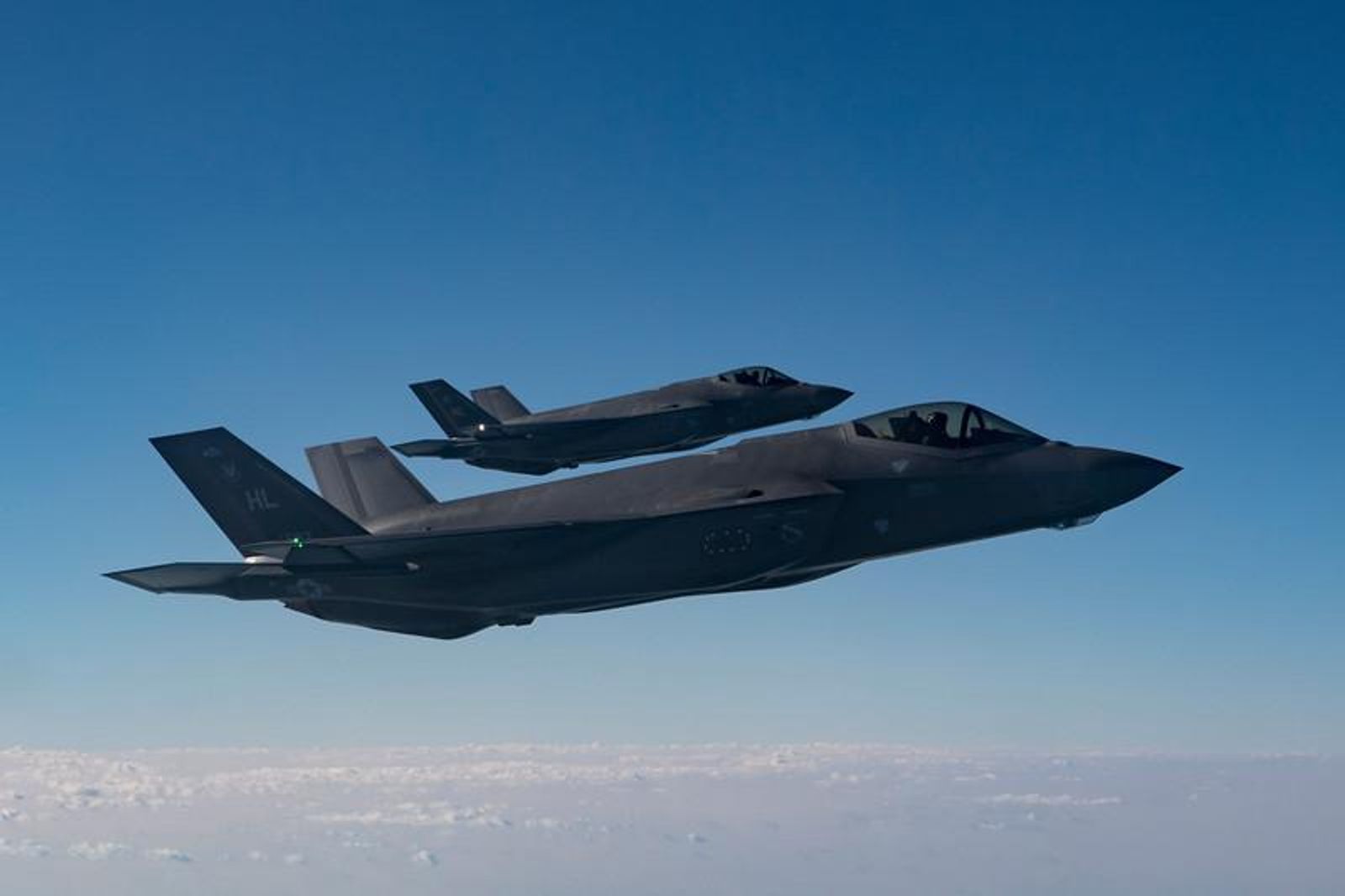
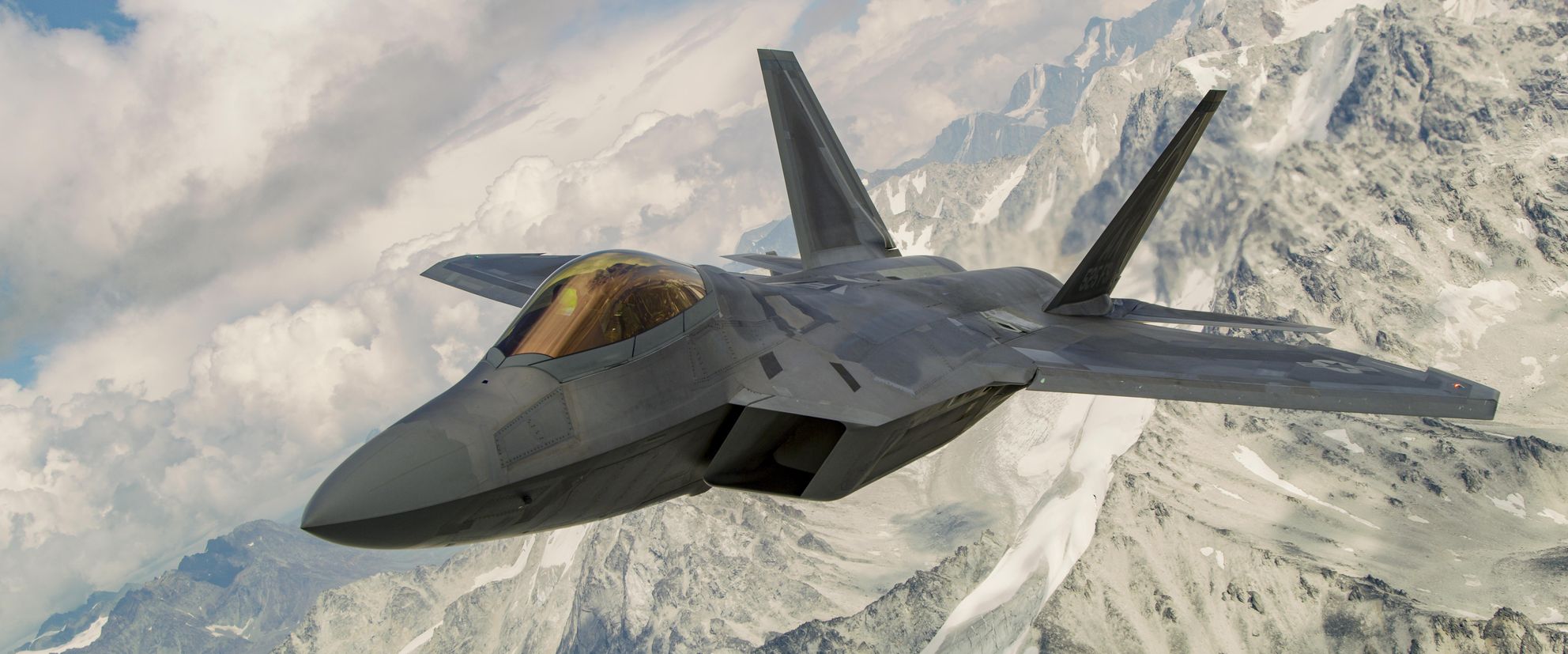
Three Lockheed Martin military aircraft, built in different eras, have different communications systems designed to make it hard for an adversary to detect a transmission. In a project called Hydra, engineers used electronic systems called open-system gateways to enable the three to communicate freely. From the top, the aircraft are the F-22, the U-2S, and the F-35. Lockheed Martin
At least, that’s the goal. The reality often falls short. The networks that knit together all these sensors are a patchwork. Some of them run over civilian commercial infrastructure and others are military, and among the military ones, different requirements among the different branches and other factors have contributed to an assortment of high-performance but largely incompatible communication protocols. Messages may not propagate across these networks quickly or at all.
Here’s why that’s a problem. Say that an F-35 detects an incoming ballistic missile. The aircraft can track the missile in real time. But today it may not be able to convey that tracking data all the way to antimissile batteries in time for them to shoot down the projectile. That’s the kind of capability the 5G.MIL initiative is aiming for.
There are broader goals, too, because future battlefields will up the ante on complexity. Besides weapons, platforms, and gear, individual people will be outfitted with network-connected sensors monitoring their location, exposures to biochemical or radioactive hazards, and physical condition. To connect all these elements will require global mesh networks of thousands of nodes, including satellites in space. The networks will have to accommodate hypersonic systems moving faster than five times the speed of sound, while also being capable of controlling or launching cyberattacks, electronic warfare and countermeasures, and directed-energy weapons.
Such technologies will fundamentally change the character and speed of war and will require an omnipresent communications backbone to manage capabilities across the entire battlefield. The sheer range of coordinated activities, the volume of assets, the complexity of their interactions, and their worldwide distribution would quickly overwhelm the computing and network capabilities we have today. The time from observation to decision to action will be measured in milliseconds: When a maneuvering hypersonic platform moves more than 3.5 kilometers per second, knowing its location even a second ago may be of little use for a system designed to track it.
Our 5G.MIL vision has two complementary elements. One is exemplified by the opening scenario of this article: the quick, ad hoc establishment of secure, local networks based on 5G technology. The goal here is to let forces take sensor data from any platform in the theater and make it accessible to any shooter, no matter how the platform and the shooter each connect to the network.
Lockheed Martin
Aircraft, ships, satellites, tanks, or even individual soldiers could connect their sensors to the secure 5G network via specially modified 5G base stations. Like commercial 5G base stations, these hybrid base stations could handle commercial 5G and 4G LTE cellular traffic. They could also share data via military tactical links and communications systems. In either case, these battlefield connections would take the form of secure mesh networks. In this type of network, nodes have intelligence that enables them to connect to one another directly to self-organize and self-configure into a network, and then jointly manage the flow of data.
Inside the hybrid base station would be a series of systems called tactical gateways, which enable the base station to work with different military communication protocols. Such gateways already exist: They consist of hardware and software based on military-prescribed open-architecture standards that enable a platform, such as a fighter jet made by one contractor, to communicate with, say, a missile battery made by another supplier.
The second element of the 5G.MIL vision involves connecting these local mesh networks to the global Internet. Such a connection between a local network and the wider Internet is known as a backhaul. In our case, the connection might be on the ground or in space, between civilian and military satellites. The resulting globe-spanning backhaul networks, composed of civilian infrastructure, military assets, or a mixture of both, would in effect create a software-defined virtual global defense network.
The software-defined aspect is important because it would allow the networks to be reconfigured—automatically—on the fly. That’s a huge challenge right now, but it’s critical because it would provide the flexibility needed to deal with the exigencies of war. At one moment, you might need an enormous video bandwidth in a certain area; in the next, you might need to convey a huge amount of targeting data. Alternatively, different streams of data might need different levels of encryption. Automatically reconfigurable software-defined networks would make all of this possible.
The military advantage would be that software running on the network could use data sourced from anywhere in the world to pinpoint location, identify friends or foes, and to target hostile forces. Any authorized user in the field with a smartphone could see on a Web browser, with data from this network, the entire battlefield, no matter where it was on the planet.
We partnered recently with the U.S. Armed Services to demonstrate key aspects of this 5G.MIL vision. In March 2021, Lockheed Martin’s Project Hydra demonstrated bidirectional communication between the Lockheed F-22 and F-35 stealth fighters and a Lockheed U-2 reconnaissance plane in flight, and then down to ground artillery systems.
This latest experiment, part of a series that began in 2013, is an example of connecting systems with communications protocols that are unique to their mission requirements. All three planes are made by Lockheed Martin, but their different chronologies and battlefield roles resulted in different custom communications links that aren’t readily compatible. Project Hydra enabled the platforms to communicate directly via an open-system gateway that translates data between native communications links and other weapons systems.
Emerging technologies will fundamentally change the character and speed of war and will require an omnipresent communications backbone to manage capabilities across the entire battlefield.
It was a promising outcome, but reconnaissance and fighter aircraft represent only a tiny fraction of the nodes in a future battle space. Lockheed Martin has continued to build off Project Hydra, introducing additional platforms in the network architecture. Extending the distributed-gateway approach to all platforms can make the resulting network resilient to the loss of individual nodes by ensuring that critical data gets through without having to spend money to replace existing platform radios with a new, common radio.
Another series of projects with a software platform called HiveStar showed that a fully functional 5G network could be assembled using base stations about the size of a cereal box. What’s more, those base stations could be installed on modestly sized multicopters and flown around a theater of operations—this network was literally “on the fly.”
The HiveStar team carried out a series of trials this year culminating in a joint demonstration with the U.S. Army’s Ground Vehicle Systems Center. The objective was to support a real-world Army need: using autonomous vehicles to deliver supplies in war zones.
The team started simply, setting up a 5G base station and establishing a connection to a smartphone. The base-station hardware, a gNodeB in industry parlance, was an OctNode2, from Octasic in Montreal. The base station weighs about 800 grams and measures about 24 × 15 × 5 centimeters.
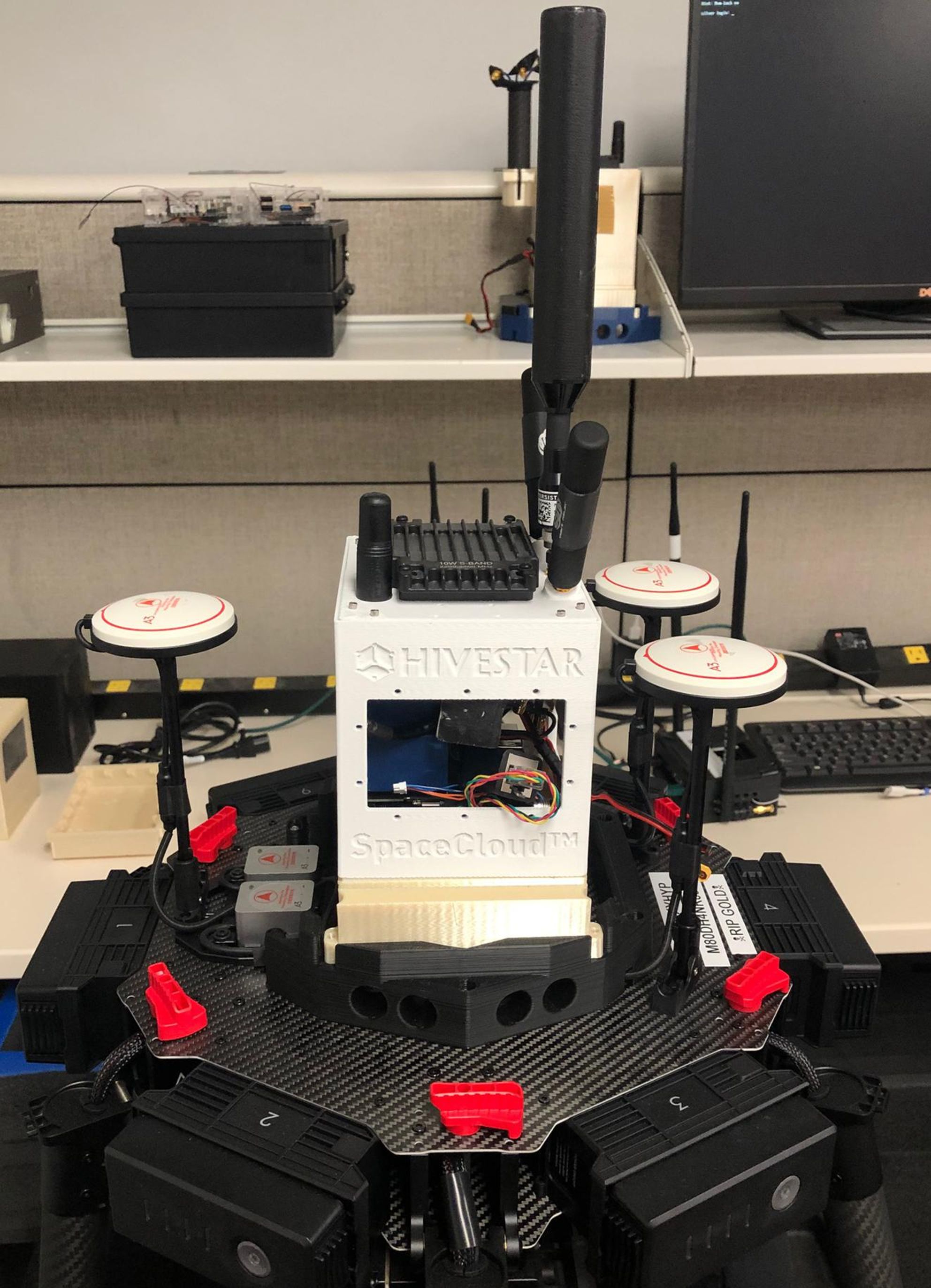
A white 3-D printed box housed processors for distributed-computing and communications software, called HiveStar. The housings were mounted on unpiloted aerial vehicles for a demonstration of a fully airborne 5G network.Lockheed Martin
The team then tested the compact system in an area without existing infrastructure, as might very well be true of a war zone or disaster area. The team mounted the gNodeB and a tactical radio operating in the S band on a DJI Matrice 600 Pro hexacopter and flew the package over a test range at Lockheed Martin’s Waterton, Colo., facility. The system passed the test: It established 5G connectivity between this roving cell tower in the sky with a tablet on the ground.
Next, the team set about wirelessly connecting a group of base stations together into a flying, roving heterogeneous 5G military network that could perform useful missions. For this they relied on Lockheed-Martin developed software called HiveStar, which manages network coverage and distributes tasks among network nodes—in this case, the multicopters cooperating to find and photograph the target. This management is dynamic: if one node is lost to interference or damage, the remaining nodes adjust to cover the loss.
For the team’s first trial, they chose a pretty standard military chore: locate and photograph a target using multiple sensor systems, a function called tip and cue. In a war zone such a mission might be carried out by a relatively large UAV outfitted with serious processing power. Here the team used the gNodeB and S-band radio setup as before, but with a slight difference. All 5G networks need a software suite called 5G core services, which is responsible for such basic functions as authenticating a user and managing the handoffs from tower to tower. In this trial, those core functions were running on a standard Dell PowerEdge R630 1U rack-mounted server on the ground. So the network consisted of the gNodeB on the lead copter, which communicated with the ground using 5G and depended on the core services on the ground computers.
The lead copter communicated using S-band radio links, with several camera copters and one search copter with a software-defined radio programmed to detect an RF pulse in the target frequency. The team worked with the HiveStar software, which managed the network’s communications and computing, via the 5G tablet. All that was needed was a target for the copters to search for. So the team outfitted a remotely controlled toy jeep, about 1 meter long, with a software-defined radio emitter as a surrogate target.
The team initiated the tip-and-cue mission by entering commands on the 5G tablet. The lead copter acted as a router to the rest of the heterogeneous 5G and S-band network. Messages initiating the mission were then distributed to the other cooperating copters via the S-band radio connection. Once these camera platforms received the messages, their onboard HiveStar mission software cooperated to autonomously distribute tasks among the team to execute search maneuvers. The multicopters lifted off in search of the target RF emitter.
Once the detecting copter located the target jeep’s radio signal, the camera copters quickly sped to the area and captured images of the jeep. Then, via the 5G gNodeB, they sent these images, along with precise latitude and longitude information, to the tablet. Mission accomplished.
Next the team thought of ways to fly the entire 5G system, freeing it from any dependence on specific locations on the ground. To do this, they had to put the 5G core services on the lead copter, the one outfitted with the gNodeB. Working with a partner company, they loaded the core services software onto a single board computer, an Nvidia Jetson Xavier NX, along with the gNodeB. For the lead copter, which would carry this gear, they chose a robust, industrial-grade quadcopter, the Freefly Alta X. They equipped it with the Nvidia board, antennas, filters, and the S-band radios.
Lockheed Martin
At the Army’s behest, the team came up with a plan to use the flying network to demonstrate leader-follower autonomous-vehicle mobility. It’s a convoy: A human drives a lead vehicle, and up to eight autonomous vehicles follow behind, using routing information transmitted to them from the lead vehicle. Just as in the tip-and-cue demonstration, the team established a heterogeneous 5G and S-band network with the upgraded 5G payload and a series of supporting copters that formed a connected S-band mesh network. This mesh connected the convoy to a second, identical convoy several kilometers away, which was also served by a copter-based 5G and S-band base station.
After the commander initiated the mission, the Freefly Alta X flew itself above the lead vehicle at a height of about 100 meters and connected to it via the 5G link. The HiveStar mission-controller software directed the supporting multicopters to launch, form, and maintain the mesh network. The vehicle convoy started its circuit around a test range about 10 km in circumference. During this time, the copter connected via 5G to the lead convoy vehicle would relay position and other telemetric information to the other vehicles in the convoy, while following overhead as the convoy traveled at around 50 km per hour. Data from the lead vehicle was shared by this relay to following vehicles as well as the second convoy via the distributed multicopter-based S-band mesh network.
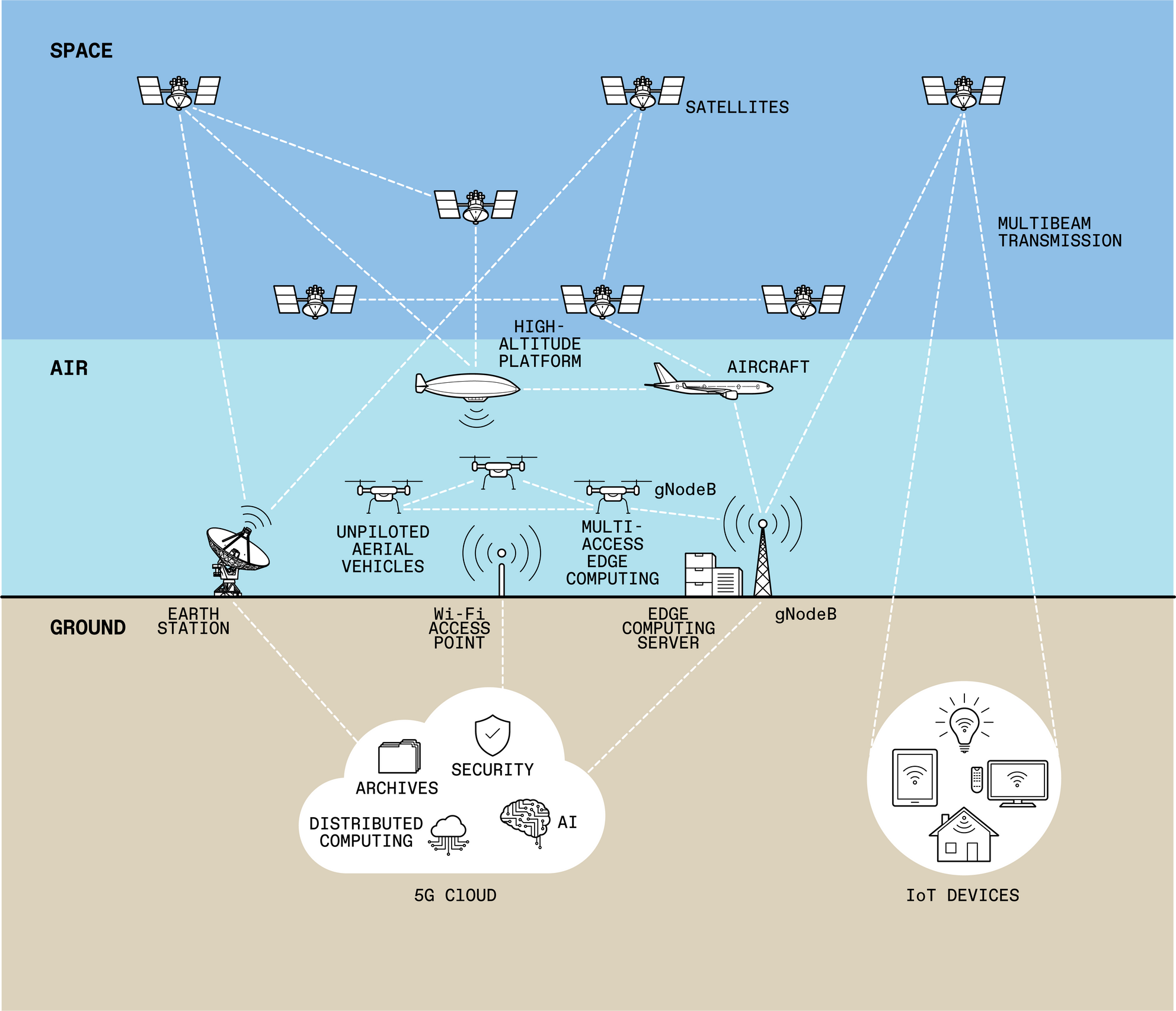
Current 5G standards do not include connections via satellites or aircraft. But planned revisions, designated Release 17 by the 3rd Generation Partnership Project consortium, are expected next year and will support nonterrestrial networking capabilities for 5G.Chris Philpot
The team also challenged the system by simulating the loss of one of the data links (either 5G or S-band) due to jamming or malfunction. If a 5G link was severed, the system immediately switched to the S band, and vice versa, to maintain connectivity. Such a capability would be important in a war zone, where jamming is a constant threat.
Though encouraging, the Hydra and HiveStar trials were but first steps, and many high hurdles will have to be cleared before the scenario that opens this article can become reality. Chief among these is expanding the coverage and range of the 5G-enabled networks to continental or intercontinental range, increasing their security, and managing their myriad connections. We are looking to the commercial sector to bring big ideas to these challenges.
Satellite constellations, for instance, can provide a degree of global coverage, along with cloud-computing services via the internet and the opportunity for mesh networking and distributed computing. And though today’s 5G standards do not include space-based 5G access, the Release 17 standards coming in 2022 from the 3rd Generation Partnership Project consortium will natively support nonterrestrial networking capabilities for the 5G ecosystem. So we’re working with our commercial partners to integrate their 3GPP-compliant capabilities to enable direct-to-device 5G connectivity from space. In the meantime, we’re using the HiveStar/multicopter platform as a surrogate to test and demonstrate our space-based 5G concepts.
Security will entail many challenges. Cyberattackers can be counted on to attempt to exploit any vulnerabilities in the software-defined networking and network-virtualization capabilities of the 5G architecture. The huge number of vendors and their suppliers will make it hard to perform due diligence on all of them. And yet we must protect against such attacks in a way that works with any vendor’s products rather than rely, as in the past, on a limited pool of preapproved solutions with proprietary (and incompatible) security modifications.
The advent of ultrafast 5G technology is an inflection point in military technology.
Another interesting little challenge is presented by the 5G waveform itself. It’s made to be easily discovered to establish the strongest connection. But that won’t work in military operations where lives depend on stealth. Modifications to the standard 5G waveform, and how it’s processed within the gNodeB, can achieve transmission that’s hard for adversaries to pick up.
Perhaps the greatest challenge, though, is how to orchestrate a global network built on mixed commercial and military infrastructure. To succeed here will require collaboration with commercial mobile-network operators to develop better ways to authenticate user connections, control network capacity, and share RF spectrum. For software applications to make use of 5G’s low latency, we’ll also have to find new, innovative ways of managing distributed cloud-computing resources.
It’s not a leap to see the advent of ultrafast 5G technology as an inflection point in military technology. As artificial intelligence, unpiloted systems, directed-energy weapons, and other technologies become cheaper and more widely available, threats will proliferate in both number and diversity. Communications and command and control will only become more important relative to more traditional factors such as the physical capabilities of platforms and kinetic weapons. This sentiment was highlighted in the summary of the 2018 U.S. National Defense Strategy, the strategic guidance document issued every four years by the U.S. DOD: “Success no longer goes to the country that develops a new technology first, but rather to the one that better integrates it and adapts its way of fighting.”
Here, it is worth noting that Chinese companies are among the most active in developing 5G and emerging 6G technologies. Chinese firms, notably Huawei and ZTE Corp., have more than 30 percent of the worldwide market for 5G technology, similar to the combined market shares of Ericsson and Nokia. Chinese market share could very well increase: According to the Council on Foreign Relations, the Chinese government backs companies that build 5G infrastructures in countries China invests in as part of its Belt and Road Initiative. Meanwhile, in Europe, NATO unveiled its first 5G military test site in Latvia in 2020. Norway, notably, is exploring dedicating software-defined networks in commercial 5G infrastructure to support military missions.
Perhaps this convergence of commercial and defense-sector development around 5G, 6G, and future communications technologies will lead to powerful and unexpected commercial applications. The defense sector gave the world the Internet. The world now gives militaries 5G communications and beyond. Let’s find out what the defense sector can give back.
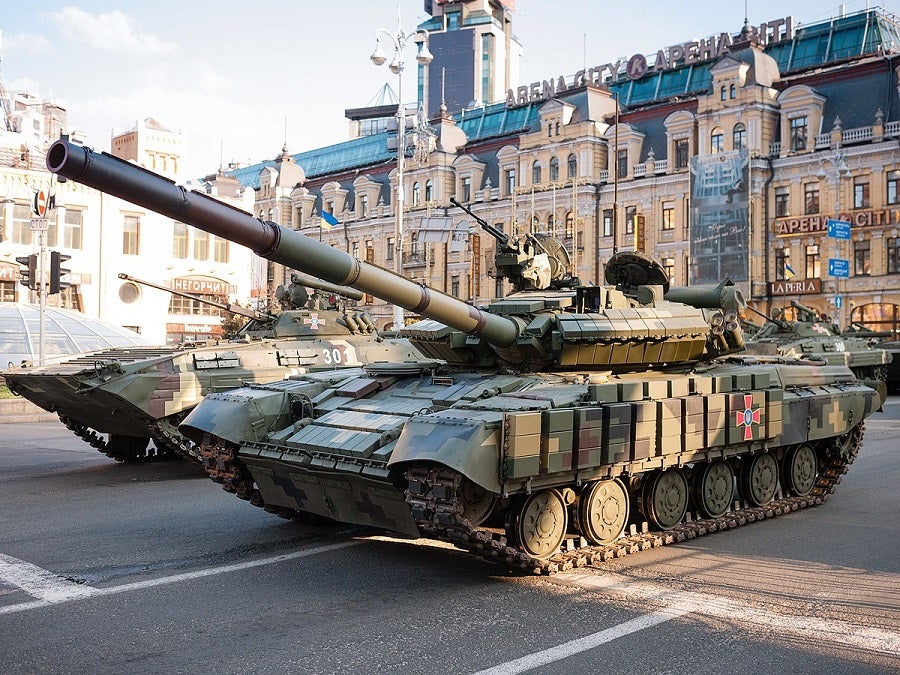
Comparing one tank to another is futile if the two may never meet in battle. If President Putin, however, decides to invade Ukraine, there’s little doubt both sides will deploy tanks.
Ukraine has been receiving military aid from the US and other NATO allies since the end of last year, including weapons that NATO hopes will be enough to deter a potential Russian invasion. One argument is that military support for Ukraine would make it significantly more difficult for Russia to achieve victory.
Increased military strength for Kyiv could also mean increased costs – in terms of money and lives – for the Kremlin. This, some hope, would create domestic political trouble for President Putin and he would decide against an invasion.
Other experts think all efforts are futile and arming Ukraine further only pushes Russia closer to an invasion. Either way, if or when it comes to an actual invasion, increased Ukrainian capability would still not be enough to compete with Moscow’s prowess.
But just how much stronger the Russian military is? Whereas the Russian Air Force would conduct airstrikes on certain Ukrainian assets, most of the fighting would take place on the ground. We compare each country’s fighting vehicle capabilities.
Ukraine
According to a GlobalData 2021 equipment inventory of Ukrainian military equipment, the country currently owns approximately 12,300 armoured vehicles, of which about 2,550 are tanks. On a world scale, these figures rank Ukraine sixth and 13th, respectively. This includes main battle tanks, light tanks and tank destroyers.
T-64 main battle tank
The most notable Ukrainian tank is perhaps the T-64 main battle tank (MBT), of which the country has 720. The Ukrainian Kharkiv Locomotive Factory designed and produced the T-64 and it entered service during the Cold War in 1966.
The vehicle was a massive leap from the then respected T-55 and T-62 models. The T-64 is fitted with the Kontakt-1 reactive armour which covers the particularly vulnerable areas of the tank. Upgrades from previous models include a better diesel engine and the replacement of personnel-operated loaders with an autonomous device.
The 125mm smoothbore cannon is now standard, but the T-64 was the first Soviet tank to receive it and it can also fire the anti-tank guided missile AT-8 Songster. The AT-8 has a single high-explosive anti-tank warhead, it can penetrate at least 600mm of steel armour and can engage armoured vehicles up to 4km.
The T-64BV model is also equipped with a 7.62mm coaxial machine gun, a 12.7mm Nikitina-Sokolova-Volkova Tankovy machine gun and two banks of four smoke grenade dischargers. The intended purpose of the T-64s was to beat the then best NATO armoured vehicles.
The T-64s posed challenges to the Ukrainian military in maintaining it and modernised the T-64BM model and the T064BM Bulat was born. Today, the T-64s are technologically superior to most of their Russian counterparts.
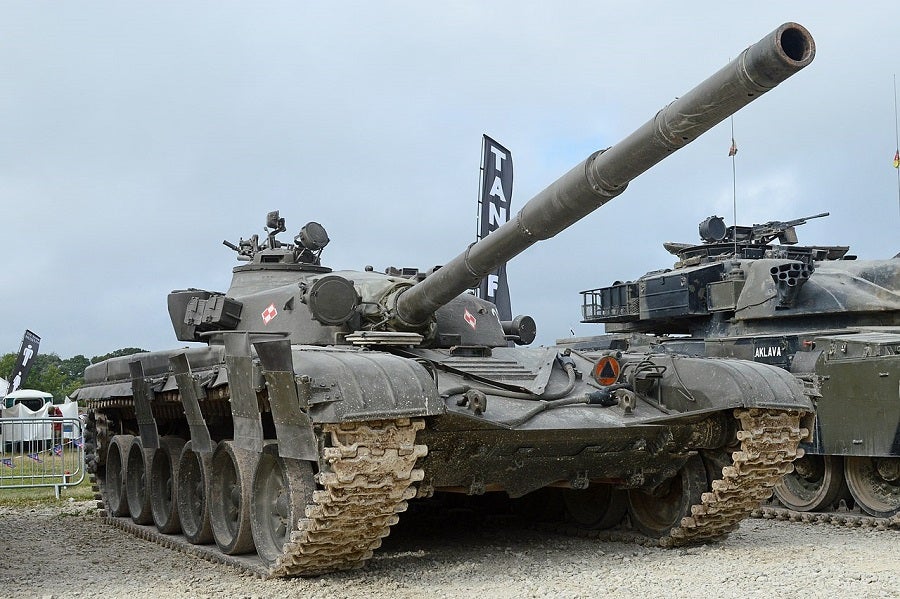
The T-72
The T-72 main battle tank is another Soviet-built main battle tank. Kyiv operates an impressive 3,600 T-72s, including the variants T-72UA1, the T-72B1, the T-72AV and the T-72A.
The T-72s are considerably less sophisticated but easier to maintain than the T-64s.
The armament of the T-72 is equal to the T-64’s and it can carry 45 rounds of 125mm ammunition, of which 22 rounds are carried on an automatic loading carousel. The gun fires separate loading armour-piercing discarding sabot rounds, high-explosive anti-tank rounds and high-explosive fragmentation projectiles.
Fire accuracy is aided by a laser rangefinder sight, ballistic computer and a thermal barrel sleeve. The tank’s anti-armour missile system is the 9K120 Svir (NATO codename AT-11 Sniper), designed by the KBP Instrument Design Bureau, Tula.
The T-72s protection includes armour plating, with combined armour arrays over the frontal arc.
Russia
Russia operates the world’s largest tank fleet with an armada more than 12,400 strong. The country’s total number of armoured vehicles reaches more than 30,100, giving Russia third place, falling 15,000 and 5,000 vehicles short of the American and Chinese fleets, respectively.
The number of T-64s and T-72s alone nearly outmatch the total Ukrainian armoured vehicle capacity.
Next-generation MBT
But an interesting Russian tank is the T-14 Armata developed by Uralvagonzavod. The MBT was unveiled in 2015 and the country’s ambition was to produce 2,300 of them. However, the mass production of the vehicle was delayed due to high costs and only about 20 vehicles are known to be operational.
Russia managed to field-test it in Syria. The combat vehicle is equipped with digitalised equipment, an uncrewed turret and an isolated armoured capsule for the crew. It is based on a modular combat platform, which can also serve as a basis for other armoured variants such as heavy infantry fighting vehicles and armoured personnel carriers.
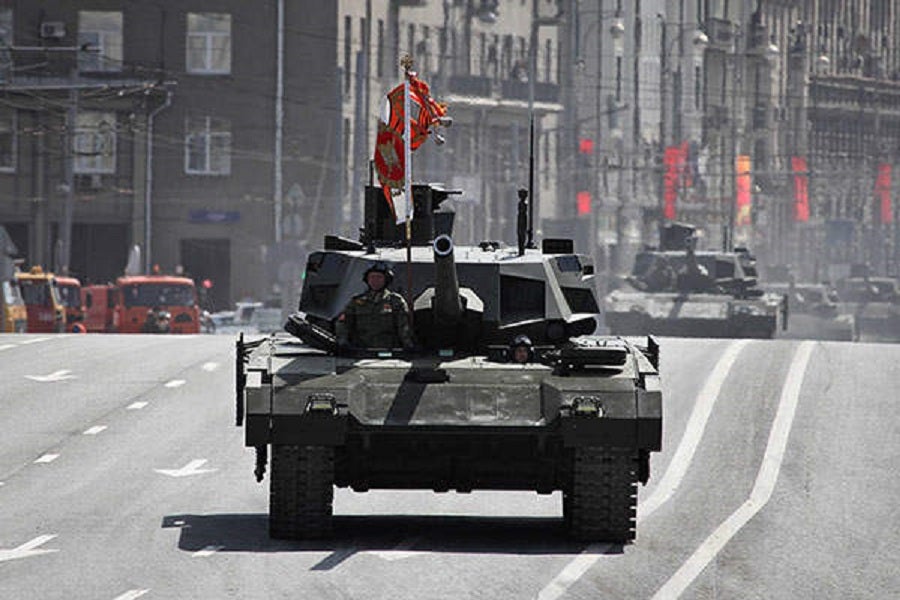
The T-14’s hull is divided into three compartments: a crew cab at forward, the remote-controlled turret with a 125mm 2A82-1M smoothbore gun in the centre and a power-pack at the rear of the tank. The main gun can also fire laser-guided missiles and might be replaced with the 152mm 2A83 in the future on some T-14s.
The tank can also be fitted with secondary weapons including a Kord 12.7mm machine gun and a PKTM 7.62mm machine gun.
The hull is equipped with a modular armour system made of steel, ceramics and composite materials. The low silhouette of the tank avoids exposing the parts to enemy fire, which significantly enhances the safety and survivability of the crew.
Survivability is further enhanced by nuclear, biological and chemical protection, automatic fire suppression systems and smoke grenade dischargers.
Probably the total of 20 T-14s would not be the main reason for Kyiv’s headache, and with the recent delivery of piles of various anti-tank missiles, Ukraine could seriously challenge a Russian advancement. However, considering Moscow would only need to deploy a fifth of its tank fleet to compete with its western neighbour, the T-14s could significantly enhance a battalion.