The US military has indicated its interest in commercial supersonic flight by granting as much as $60 million to Boom Supersonic for its airliner development efforts.
The Colorado-based company has announced that the Air Force awarded a three-year contract to Boom to accelerate research and development of its Overture airliner. Separately this week, Boom selected Piedmont
Triad International Airport in Greensboro, North Carolina, as the site of its first full-scale manufacturing facility. There, Boom plans to begin production in 2024, with the first Overture aircraft slated to roll out in 2025, fly in 2026, and carry its first passengers by 2029.
Boom is designing Overture to carry between 65 and 88 passengers at subsonic speeds over land and supersonic speeds over water—more than twice as fast as current commercial aircraft. The aircraft is designed to operate on 100 percent “sustainable” fuels, and the company says the vehicle will be net-zero carbon from day one.
The Air Force is interested in the technology for rapid global travel and logistics, with potential applications such as executive transport, special operations, and reconnaissance. The Air Force is making this investment through its AFWERX program, which seeks to foster innovation within the military and bring commercial technologies to operational status more quickly. The funding for Boom, known as a Strategic Funding Increase (or STRATFI), represents a siz
able bet on supersonic aviation.
“With STRATFI, we’re able to collaborate with the Air Force on the unique requirements and needs for global military missions, ultimately allowing Boom to better satisfy the needs of the Air Force where it uses commercially derived aircraft,” Boom founder and CEO Blake Scholl said in a news release. “As a potential future platform for the Air Force, Overture would offer the valuable advantage of time, an unmatched option domestically and internationally.”
The government funding also represents a timely vote of confidence for Boom, which is among a number of startup companies working to develop supersonic aircraft for commercial passenger service. The money could help Boom raise additional private capital to fully fund Overture, which will require an enormous upfront investment. Boom estimates it will take $6 to $8 billion to develop Overture.
Despite two high-profile attempts last century, supersonic flight for commercial air travel has been dead for about two decades. The Soviet Tupolev supersonic aircraft flew just a few dozen commercial flights back in 1977, and the Concorde, flown by British Airways and Air France beginning in 1976, retired in 2003 after economic problems were compounded by a fatal accident in 2000.
Now, with a combination of new technologies, private capital, and efforts by NASA and others to study ways to dilute the impact of sonic booms over land, interest in supersonic commercial travel has been renewed. Outsiders, on the other hand, may have a hard time seeing past all the PR and renderings to know which companies might actually bring an aircraft into service.
The US Air Force presumably has better access to pertinent data, and now it has made a sizable bet on Boom. In turn, Boom is putting down manufacturing roots in a state where powered aircraft first took flight. Perhaps a new generation of commercial supersonic air travel will become a reality after all.
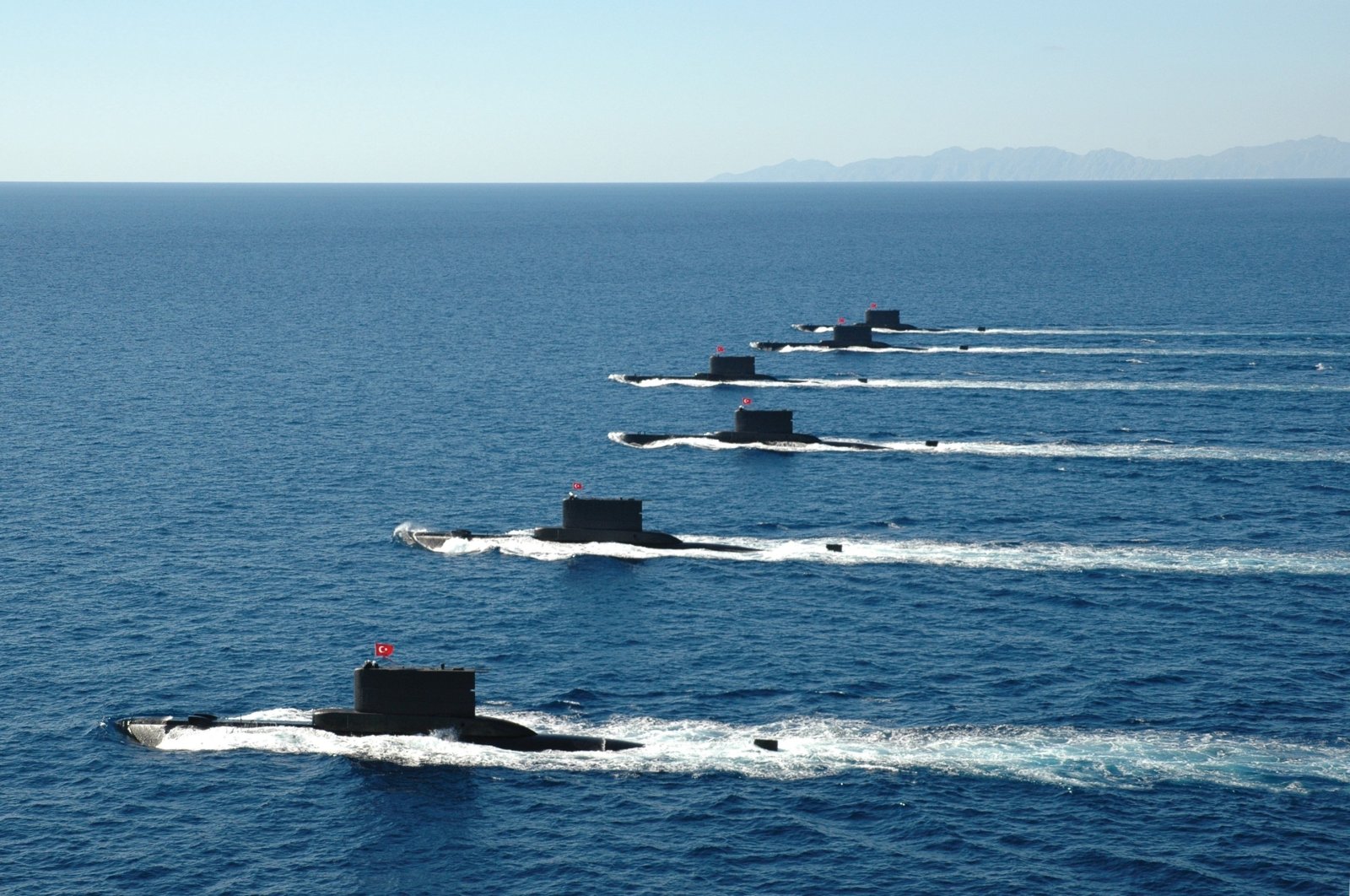
STM modernized the Turkish Naval Forces Command’s submarines. (Courtesy of STM)
After securing great success in developing, operating and exporting its domestic unmanned aerial vehicles (UAVs), Turkey is preparing for similar success stories with mini-submarines in the near future. A defense and maritime researcher said the “game changer” combat drones will have an equivalent in mini-submarines that can operate in the “Blue Homeland” that represents the seas surrounding the country.
Kozan Selçuk Erkan, who is one of the experts closely following developments, speaking on Turkey’s submarine building skills, told state broadcaster TRT Haber that there “is a quiet and deep process in line with the spirit of the submarine.”
Stating that Ankara has acquired this strategic approach thanks to the submarine construction programs that have been going on since the 1980s, Erkan points out that more localization rates and new production skills are gained with each new production.
With the development of the Reis class submarines – air-independent propulsion-system submarines developed under the New Type Submarine Project – the country’s industry has reached much higher levels, Erkan said.
Commenting on the mini-submarines, Erkan underlined that small submarines, due to their nature, will be more difficult to develop because too many subsystems need to be built into small volumes.
“But this is something our shipbuilding industry can handle now,” he said.
He said that the mini-submarine, coded as STM-500, which was developed by STM that has previously undertaken an important role in the development of the Reis class submarines, will be a platform where the rate of the domestically produced parts is set to be much higher.
“Everyone knows what kind of embargoes our country is exposed to on some strategic subsystems,” he commented, noting that “with the mini-submarines we will produce, a class will emerge in which foreign dependency in this area will remain at the lowest level.”
Describing these platforms as “powerful, high-range vehicles that can stay underwater for a long time,” Erkan pointed to Turkey’s geostrategic position, explaining: “It may not be possible to achieve the desired result with large submarines in areas such as the Aegean Sea, which is also known as the Sea of Islands, with a partially shallow depth, and the Black Sea, which is a closed sea.
“Turkey, which is on the way to becoming a global player, does need submarines like the Reis class, where technology is at the highest level.” He went on to say, “however, mini-submarines, which are cost-effective to manufacture and operate, are of vital importance for us as well for near waters.”
The products produced by Turkey in the defense industry find buyers in different markets of the world, Erkan said, and “Turkey has risen to the top league in the military shipbuilding industry in recent years,” he added.
“As for mini-submarines, we are exactly in the position of tactical class UAVs … When Turkey started to produce tactical class UAVs, there were only large class or expensive tactical UAVs in the world. It would not be wrong to say that Ankara ignited this market in the world with the right choice,” he explained.
“In the small submarine class, we are exactly at the same point currently. In other words, while the West is oriented toward either very large and expensive submarines or very technological and expensive submarines, our orientation to this type of small submarine may create a different market for us,” he added.
Erkan said that many countries in the world want to have a submarine but do not want to be under the burden of operating costs.
“I believe that national mini-submarines have the potential to be a different power multiplier just like UAVs,” he said.
The Russian Navy is kicking off several simultaneous exercises, with ships from the Baltic and Black seas and its Northern Fleet sortieing from their homeports across Europe, the Kremlin has announced.
More than 140 warships and support vessels, along with 60 aircraft and a total of 10,000 personnel, will participate in the drills, according to the Russian MoD.
But the exercises have sparked alarm within Western nations in light of tensions over Ukraine. NATO countries have been surging out ships and aircraft and are accelerating planned deployments in response to Russia’s massing of troops on its border with Ukraine. Ireland protested over Russia’s plans to hold live fire exercises 240 kilometers off the Irish coast in February. Irish fisherman have pledged to disrupt the exercise, according to the BBC.
“We are letting them know that we will be fishing in our traditional fishing areas and if this has an impact on their exercise this would be considered a peaceful protest,” Patrick Murphy, chief executive of the Irish South and West Fish Producers Organization, said.
“We should be entitled to go fishing there, and if we’re fishing there then these boats, these warships, shouldn’t be having war games.”
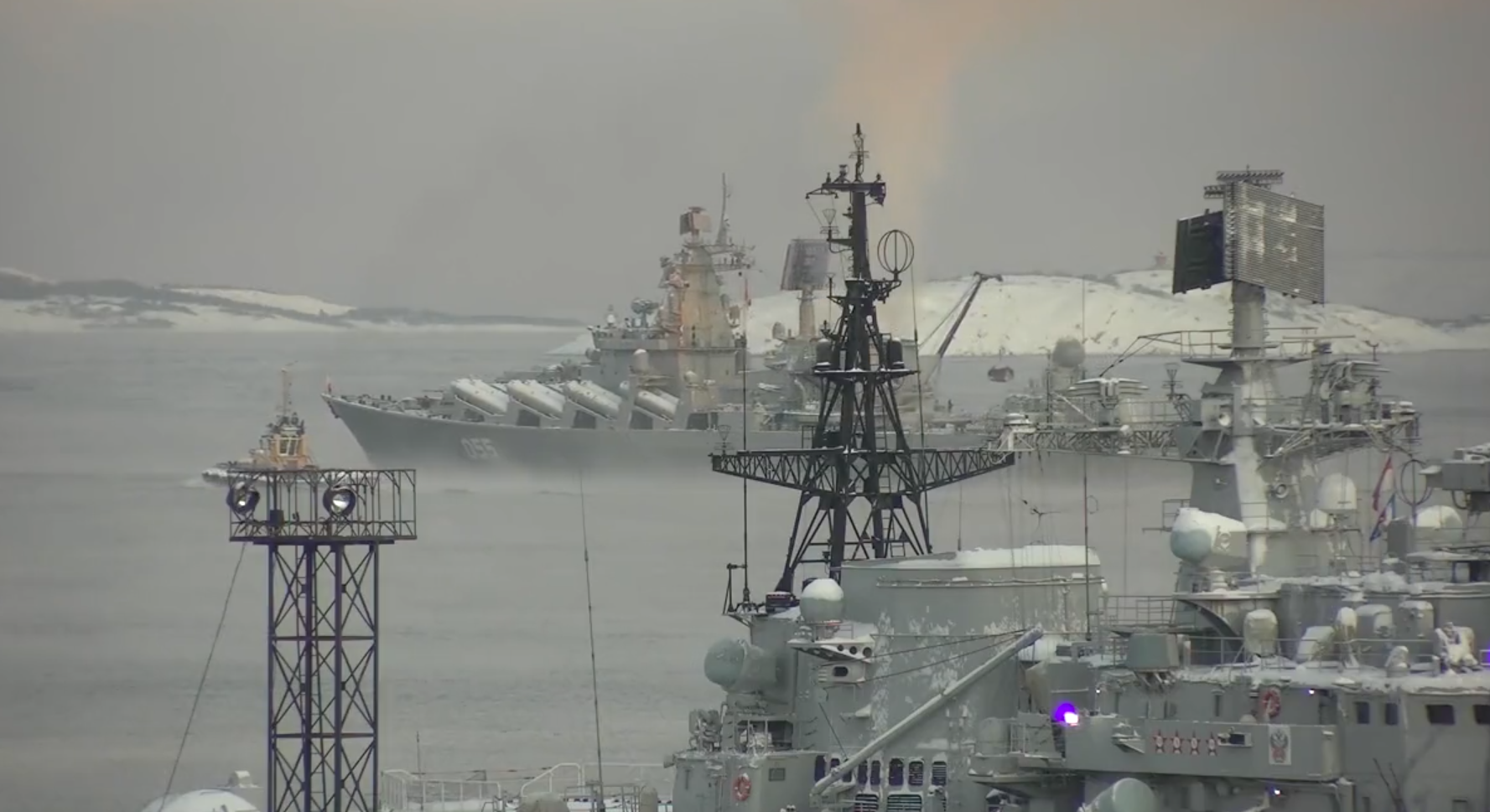
The Press Service of the Russian Northern Fleet issued two releases on Wednesday. The first said a detachment of warships and support vessels of the Northern Fleet entered the Barents Sea as part of an exercise with the Arctic Expeditionary Group of Forces and Troops. The release stated that among the ships were the cruiser RFS Marshal Ustinov (055), destroyer RFS Vice Admiral Kulakov (626), frigate RFS Admiral Flota Kasatonov (461) along with support vessels accompanying them.
Slava-class guided-missile cruiser Marshal Ustinov departs Russian Northern Fleet base Severomorsk. Russian MoD Photo
A Royal Norwegian Air Force P-3C Orion from No. 333 Squadron sighted the three warships, which were accompanied by replenishment ship Vyazma and tug SB-406, the Norwegian Armed Forces said in a Tuesday release. The Russian ships were seen at 12.20 Tuesday heading south along the Norwegian coast in the waters north of Finnmark by the P-3C, which was on a routine patrol mission. The Norwegian military did not disclose how long the P-3C followed the Russian ships, nor did it provide details on the eventual destination of the vessels, though it is likely these ships are heading to the planned live fire exercise off Ireland. It noted that Russia had announced it would be conducting major naval exercises.
A second release from Russia’s Northern Fleet said it started exercises with the Arctic expeditionary group, with Northern Fleet commander Adm. Alexander Moiseev overseeing the drills. During the exercise, the Russian Navy will evaluate the level of preparedness of the command and control organizations of the Northern fleet in planning and conducting actions to resolve crisis situations in the Arctic Ocean region, according to the news release.
The Russian Navy will also assess the coordination of actions of tactical groups of ships and units of coastal troops in the course of joint training and combat missions in the Arctic and test out tactics and methods for conducting naval combat and combat operations in the Arctic, the Northern Fleet said. It will also test out issues in protecting the communications of the Northern Sea Route and the protection and defense of Northern Fleet garrisons. The drills will include countering imaginary terrorist groups, as well as how to block and destroy them. In addition to at sea exercises, a number of exercises will take place at coastal ranges in the Murmansk region.
Up to 30 ships and submarines from the Northern Fleet, along with 20 aircraft and 1,200 personnel, will be involved in the exercise. The ships participating include destroyer RFS Severomorsk (619), frigate RFS Admiral Flota Sovetskogo SoyuzaGorshkov (454) and landing ship RFS Ivan Gren (135).
More than 20 ships of the Black Sea Fleet had departed from Sevastopol and Novorossiysk for exercises in the Black Sea, the Press Service of the Southern Military district said in a Monday news release. Minesweepers RFS Ivan Golubets, RFS Ivan Antonov and RFS Valentin Pikul carried out mine clearance for corvettes RFS Suzdalets (071) and RFS Yeysk (054), and two corvettes carried out anti-submarine drills for combatting simultaneous sea and air attacks on them, according to two releases issued today. Frigates RFS Admiral Essen (490) and RFS Ladney (861) and corvettes RFS Grayvoron (600), RFS Ingushetia (630) and RFS Naberezhnye Chelny (953) carried out air defense exercises with Russian Air Force fighter aircraft from the Southern Military District.
Meanwhile, 20 ships of the Baltic Fleet had departed their home ports to carry out exercises in the Baltic Sea, the Press Service of the Western Military District said in a Monday news release.
A separate Monday release disclosed the departure from Baltiysk of corvettes RFS Stoykiy (545) and RFS Soobrazitelny (531) for a long-range deployment that includes participation in the Russian Navy’s large scale exercise and ensuring the naval presence and display of the Russian flag in various regions of the world. It added that the ships had embarked anti-terrorist security detachments from the Baltic Fleet Marine Corps.
Over in the Arabian Sea, the Russian Pacific Fleet task group that includes cruiser RFS Varyag (011), destroyer RFS Admiral Tributs (564) and replenishment ship Boris Butoma, along with People’s Liberation Army Navy destroyer Urumqi (118) and replenishment ship Taihu (889) of the 39th Escort Task Force, carried out the joint Russian-Chinese anti-piracy exercise “Peaceful Sea-2022” on Monday. During the exercise, the Russian and Chinese ships practiced tactical maneuvering and screening, and carried out an operation to free Boris Butoma, which was acting as a seized vessel.
“The exercise further enriched the connotation of the comprehensive strategic partnership of coordination between China and Russia in the new era, accumulated useful experience for the two sides to jointly carry out anti-piracy missions, and improved the capabilities and level of the two militaries to jointly respond to maritime threats and maintain the safety of maritime strategic channels,” the Chinese Ministry of National Defense said in a news release.
The Russian Pacific Fleet Task Group is now heading to the Mediterranean Sea to join with landing ship tanks RFS Olenegorskiy Gornyak (012) and RFS Georgiy Pobedonosets (016), in addition to RFS Pyotr Morgunov (117) from the Northern Fleet and RFS Korolev (130), RFS Minsk (127), and RFS Kaliningrad (102) from the Baltic Fleet for an exercise.
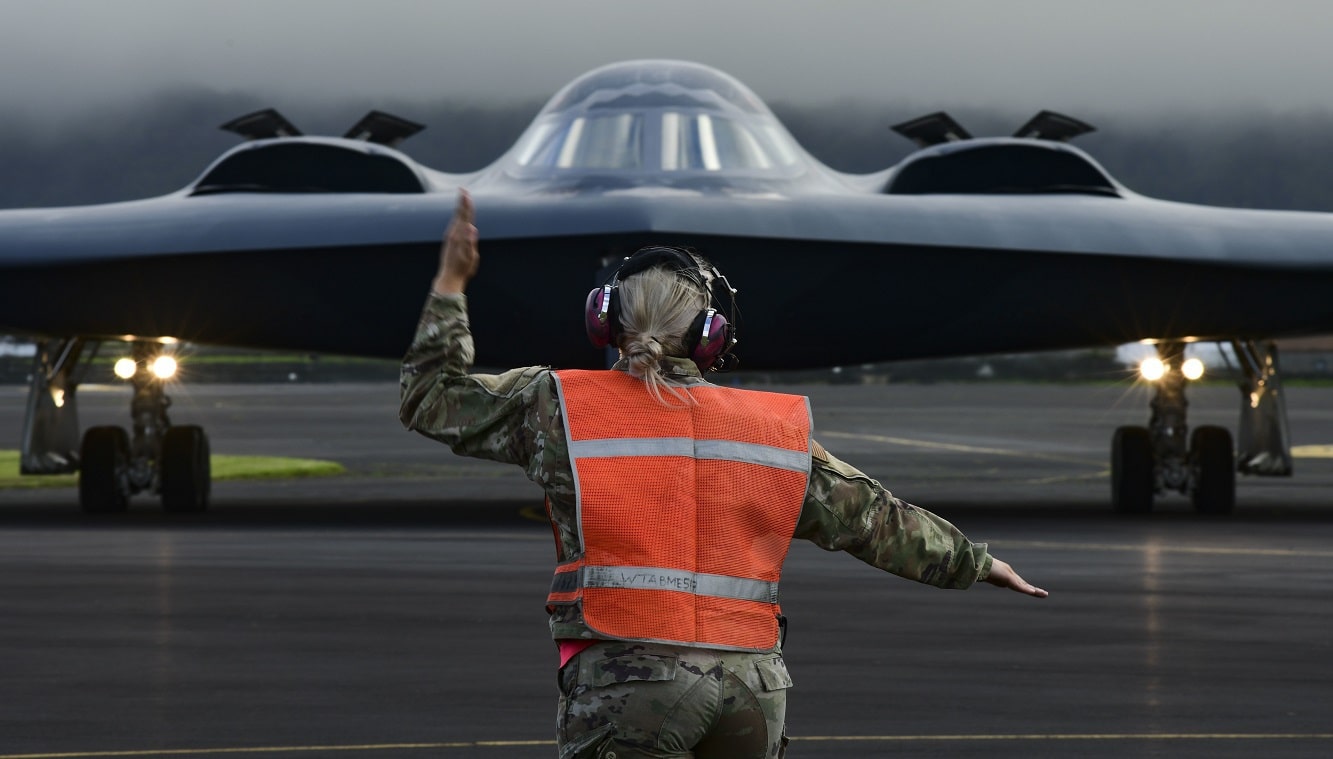
Crew chiefs assigned to the 393rd Expeditionary Bomb Squadron, prep a B-2 Spirit stealth bomber for take off, at Lajes Field, Azores, March 16, 2021. Three B-2s, assigned to Whiteman Air Force Base, Missouri, arrived at Lajes to hot-pit refuel prior to supporting several bomber task force missions in the high north. Strategic bomber missions are conducted periodically to enhance the readiness necessary to respond to challenges, in coordination with partner and allied nations, around the world. Members assigned to U.S. European Command regularly train, fight and live with allies and partners from bases in Europe, to ensure timely and coordinated responses when needed. (U.S. Air Force photo by Tech. Sgt. Heather Salazar)
The B-2 Stealth Bomber Is One Amazing Weapon of War: According to aerospace and defense company Northrop Grumman, the United States Air Force’s “B-2 stealth bomber is a key component of the nation’s long-range strike arsenal, and one of the most survivable aircraft in the world. Its unique stealth characteristics allow it to penetrate the most sophisticated enemy defenses.”
This aircraft indeed possesses remarkable stealth capabilities, but what about its firepower? Know that it was on full display when B-2 stealth bombers forged an attack on Serbia during the opening night of Operation Allied Force in 1999. It was also able to destroy Iraqi air defenses during 2003’s “Shock and Awe” and took out the Libyan fighter force in 2011.
The F-35, manufactured by Lockheed Martin, is the U.S. military’s most technologically advanced fighter jet and is used by three American military branches — the Navy, Marine Corps and Air Force. File Photo by Alex R. Lloyd/U.S. Air Force
Jan. 26 (UPI) — The U.S. Navy said it began plans Wednesday to recover and salvage an F-35 fighter jet that crashed on the aircraft carrier USS Carl Vinson early this week in the South China Sea.The crash on Monday injured multiple sailors after the sophisticated F-35C aircraft had conducted routine flight operations in the South China Sea. The pilot safely ejected and was in stable condition after being recovered by a military helicopter
The Navy said the $100 million airplane fell off the massive aircraft carrier into the South China Sea after the crash. Damage to the carrier was superficial and has already continued regular operations.
“The U.S. Navy is making recovery operations arrangements for the F-35C aircraft involved in the mishap,” said Brenda Way, spokeswoman for the Navy’s Pacific Fleet, according to ABC News.
U.S. Ambassador to Russia John Sullivan enters the Russian Foreign Ministry building in Moscow, Russia, Wednesday, Jan. 26, 2022. Sullivan delivered a U.S. response to the Russian demands for security guarantees over NATO and Ukraine. (AP Photo/Alexander Zemlianichenko)
WASHINGTON (AP) — The Biden administration and NATO told Russia on Wednesday there will be no U.S. or NATO concessions on Moscow’s main demands to resolve the crisis over Ukraine.
In separate written responses delivered to the Russians, the U.S. and NATO held firm to the alliance’s open-door policy for membership, rejected a demand to permanently ban Ukraine from joining, and said allied deployments of troops and military equipment in Eastern Europe are nonnegotiable.
“There is no change, there will be no change,” Secretary of State Antony Blinken said. Also not up for negotiation will be the U.S. and European response to any Russian invasion of Ukraine, he said, repeating the mantra that any such incursion would be met with massive consequences and severe economic costs.
The responses were not unexpected and mirrored what senior U.S. and NATO officials have been saying for weeks. Nonetheless, they and the eventual Russian reaction to them could determine whether Europe will again be plunged into war.
There was no immediate response from Russia but Russian officials have warned that Moscow would quickly take “retaliatory measures” if the U.S. and its allies reject its demands.
Seeking possible off-ramps that would allow Russia to withdraw the estimated 100,000 troops it has deployed near Ukraine’s border without appearing to have lost a battle of wills, the U.S. response did outline areas in which some of Russia’s concerns might be addressed, provided it de-escalates tensions with Ukraine.
Speaking to reporters in Washington, Blinken said Russia would not be surprised by the contents of the several-page American document that U.S. Ambassador to Russia John Sullivan delivered Wednesday to the Russian Foreign Ministry.
“All told it sets out a serious diplomatic path forward. should Russia choose it,” he said. “The document we’ve delivered includes concerns of the United States and our allies and partners about Russia’s actions that undermine security, a principled and pragmatic evaluation of the concerns that Russia has raised, and our own proposals for areas where we may be able to find common ground.”
Blinken said he hoped to speak with Russian Foreign Minister Sergey Lavrov about the response in the coming days. But he stressed the decision about pursuing diplomacy or conflict rests with Russia and, more specifically, with Russian President Vladimir Putin.
“We’ll see how they respond,” he said. “But there’s no doubt in my mind that if Russia were to approach this seriously and in a spirit of reciprocity with a determination to enhance collective security for all of us, there are very positive things in this in this document that could be pursued. We can’t make that decision for President Putin.”
Shortly after Blinken spoke, NATO Secretary-General Jens Stoltenberg said in Brussels that the alliance had sent a separate reply to Russia with an offer to improve communications, examine ways to avoid military incidents or accidents, and discuss arms control. But, like Blinken, he rejected any attempt to halt membership.
“We cannot and will not compromise on the principles on which the security of our alliance, and security in Europe and North America rest,” Stoltenberg said. “This is about respecting nations and their right to choose their own path.”
“Russia should refrain from coercive force posturing, aggressive rhetoric and malign activities directed against allies and other nations. Russia should also withdraw its forces from Ukraine, Georgia and Moldova, where they are deployed without these countries’ consent,” he said.
While flatly refusing to consider any changes to NATO’s open-door policy, its relationship with non-ally Ukraine, or allied troop and military deployments in Eastern Europe, Blinken said the U.S. is open to other ideas to ease Russia’s stated concerns.
We are writing to let you know that PartYard are closely monitoring global events related to the COVID-19 outbreak in order to safeguard personnel and minimise any potential impact to customers.
Consistent with ISO 22301 standards we have procedures which specifically address elements of crisis management tailored to pandemic events.
We are now implementing practical precautionary measures, in accordance with this plan and current government guidance, which includes restrictions on overseas travel, on visitor access to our facilities and maximising home working where possible. We will continue to monitor local and national government advice on additional measures which may become necessary in the future.
We are in regular communications with our supply chain to ensure that impact to incoming deliveries is also minimised.
All office staff who can effectively work from home will now do so and this should not affect regular updates and feedback on your deliveries. If you need to contact individuals please use normal email and mobile numbers where possible.
We will be proactively contacting customers with pending deliveries to confirm ability to receive deliveries.
After this War, the Future will came brighter then ever before.
Bruno Monteiro (CEO)
A recent innovation designed to renew obsolete, small calibre naval guns is set to hit the defence market
The new upgrade kit could revive outdated naval guns across global navies. Image: yukim
An innovative upgrade stabilising kit for obsolete small calibre naval guns has been developed by the Greek companies Miltech Hellas and Hellenic Instruments.
The new upgrade kit dubbed MLT-NGSS-2 can be installed easily on almost every existing old naval gun turret, dramatically increasing its effectiveness against surface targets such as speed boats, patrol boats, skiff vessels, unmanned surface vessels, low flying helicopters, aircraft, land targets and UAVs.
The companies say their system is a cost-effective solution for naval forces with limited budgets.
The cost of the kit and its installation – replacing obsolete equipment and electronic systems with new, light-weight, sophisticated systems – is said to be 10 per cent of the cost of a new naval gun turret.
The majority of small calibre naval guns are heavy, not stabilised, and have obsolete electrical and electronic systems. The major problem for users of these systems is that most OEMs no longer support old naval gun turrets and their subsystems, while finding spare parts is both difficult and expensive.
The MLT-NGSS-2 includes a digital gyro, compass, a new compact ruggedised computer, highly sophisticated software that allows the naval guns to neutralize moving surface, ground and aerial targets and a new electronic power supply system including new powerful motors.
The upgrade can include the MLT-TDR-10 cooled third-generation thermal camera (640x510px), a CCD day camera (Full HD 1080p), a laser range finder and GPS. The rest of the hardware remains the same, contributing to the further reduction in the cost of the package.
The creators behind the technology claim a trove of other benefits aside to cost reduction on use and maintenance, including a dramatic improvement of firing accuracy, expanded lifespan, improved self-defence capabilities for the vessels, and enhanced capability to neutralise aerial, surface, and land enemies through the of existing in-stock ammunition.
Furthermore, the new upgrade kit contributes to the reduction of weight and a lower risk of the naval gun turret malfunctioning as most of the obsolete mechanical and electronic equipment is replaced with fresh equipment that boasts the advantages of being lightweight and easy to maintain.
The development of the MLT-NGSS-2 is now at its final evaluation stage and Miltech Hellas and Hellenic Instruments will soon begin a 6-month testing period on a 40 year old gun turret.
The defence industry would be best served by maintaining ‘simplicity’ when dealing with increasingly complex cyber threats, say security experts
When it comes to managing highly sensitive information, the defence industry undoubtedly sits in the top bracket of at-risk sectors.
From the leak of personal details and correspondence through private companies like Stratfor and Niteworks, to the hacking of intellectual property on major programmes run by Lockheed Martin and Boeing, there is no sign of respite from hackers seeking compromising data. This week’s headlines are even spilling details on attempts to break into US voting machine manufacturers.
In spite of these enormous risks, the defence industry is notorious for being – compared to other commercial industries – slow to meet the rapid developments in the digital world. The information security sector is, in contrast, fast-paced and ever-changing. So can defence firms close the gap in time or will the gulf eventually become too vast to bridge?
The threat
“In the defence sector, whatever sophistication, technology or skillsets you are using to defend yourself, the attackers are as skilled, organised and as well resourced,” said Piers Wilson, head of product management at information software company Huntsman Security.
“As a defender you have to cover everything all the time but as an attacker you have to find one weakness on one day. The resource constraints, the skills shortages and the fact that people have to go home at the end of the day are your realities. The adversary doesn’t have to worry about those things.”
The concept of the advanced persistent threat (APT) typically describes an adversary that will target a specific system and pull out all the stops to steal the data inside. In many cases, attacks on defence companies are APT attacks and are often led or financed by a nation state – meaning the opponent’s skills and technologies are cutting-edge.
One of the defensive tactics that cyber security firms are taking is to engineer platforms that use a multi-layered approach to protection, from basic email filters through to cloud sandboxes that vet untested programs within a safe environment before they reach the server.
As an example, the WannaCry ransomware attack combined a sophisticated infection tool with modern encryption data that attempted to evade the sandbox by playing dead if it detected that it was running within a virtual machine rather than in a physical server. But this tactic was not fool-proof.
Chris Ross of Barracuda Networks, who have clients that were targeted by the worm, explained that the company’s sandbox is able to disguise itself as a full server – something many platforms do not do – and therefore WannaCry did not know it was being quarantined.
“When it subsequently tried to release its malware, we caught it,” said Ross.
“Aside to stopping the threat in the first instance, that action enabled our sandbox and APT cloud service to grow over 7,000 per cent during the weekend of the Wannacry outbreak. That meant we were able to block over 1.35 million of the same attacks on our customers.”
While technology is doing its best to get ahead of these threats, the human factor still remains the weakest link, with many breaches caused by people clicking on bad links or simply failing to patch their systems regularly. This means IT managers must enact increasingly strict regulations on who can access what.
“From an APT perspective, getting the segmentation policies right is vital,” says William Culbert, director of solutions engineering at Bomgar, which specialises in privileged access control.
“Once you have a credential, you have a foothold into the network. That account can be quickly elevated to a privileged account, at which point you have autonomy across the infrastructure. As APT attackers are frequently in place for just under a year before the actual attack happens, that allows plenty of time to undertake reconnaissance and find the protocols used for sharing files across the network and then exploit them.”
Most audits show there are typically three to four times as many privileged accounts as there is staff in an organisation, so the attack surface can be massive.
CyberArk, another security company that specialises in privilege controls and APT protection revealed that it recently undertook a ‘red team exercise’ on a large corporation to test its resilience to these types of exploits.
Matt Middleton-Leal, the company’s UK and Ireland director, said: “It took our guy just eleven minutes to take complete control of the domain controller (the server that responds to security authentication requests). There was no way to stop him.”
Keeping it simple:
In an environment reluctant to change, many defence companies assume that a complex threat will require a complex solution – or will at least require big sums to introduce and manage new technology. But infosec experts suggest simplicity will in fact offer the best return.
“Defence firms have to find vendors with solutions that are easy to deploy and easy to manage,” said Ross.
“They should be thinking about finding one vendor rather than several to protect multiple threat vectors from email to firewalls. Managing things from one central platform reduces the resistance to change that firms may experience because taking that approach will greatly reduce management overhead costs.”
“The reality is that they have to change the approach they take as businesses,” added Middleton-Leal.
“If you build simple, intuitive security that doesn’t compromise usability, people stop trying to find ways around the controls, which is often where the problems first arise.”
As Defence IQ’s recent report – ‘Countering violent extremism online: 2017’ – examines, there is a demand for new tactics when it comes to fighting the online war against radical groups. While some success has been made, many of the latest terrorist attacks are believe to have been at least partly facilitated through online engagement, be it in recruiting of impressionable people to undertake violent acts or in organising the logistics of these attacks.
The issue has become a key concern for world leaders. Theresa May told the United Nations general assembly last week that tech companies must go “further and faster” in reclaiming the internet from those with violent intentions.
From a technology standpoint, many governments and social media platforms are indeed focusing on developing new tools and resources that can be used to address a broad range of threats to law enforcement and to the public at large.
“There are a number of different and interesting avenues being built around this,” Defence IQ was told by an insider for social media activity at the National Counterterrorism Center (NCTC) who asked not to be named.
“There are a lot of lessons we can learn from the way advertising companies approach audience identification and segmentation, and message delivery.”
“The hashtag database that was announced by Facebook, Google, Microsoft and Twitter has great potential. And the Redirect method – developed by Google’s Jigsaw and UK-based start-up Moonshot CVE – has shown benefits.”
But the representative also admitted that the CVE Task Force has extremely limited funds to draw on while they look to develop information-sharing products. Even with the expertise of DARPA (Defense Advanced Research Projects Agency), which has been developing technology in this space to help identify the people behind extremist posts, there is still a limitation on what can be done.
“Truth be told, online CVE is still an area where I think there’s a lot of potential for technological solutions,” the NCTC source explained.
“One of the most interesting things over the last few years has been the increasing focus on advertising technology, with the likes of tracking software and chatbots. Those solutions are not necessarily a silver bullet, but the way they approach audience identification and segmentation, and message delivery, there are a lot of lessons being learned. We should be looking very closely at that.”
“The last few years have been interesting to watch this technology evolve, but the next few years are going to be even more exciting.”
The NCTC representative also pointed to developments now being made in artificial intelligence and machine-learning, calling them a potential “game changer” for CVE over the next few years.
”It will allow us to get into much better datasets,” the source said.
“Of course, that means the further we get into that space, the more we will invite a new basket of questions. Who is going to host these huge datasets? Is it appropriate for the government to hold that data? These are the questions on the horizon that we need to begin preparing to answer. The last few years have been interesting to watch this technology evolve, but the next few years are going to be even more exciting.”